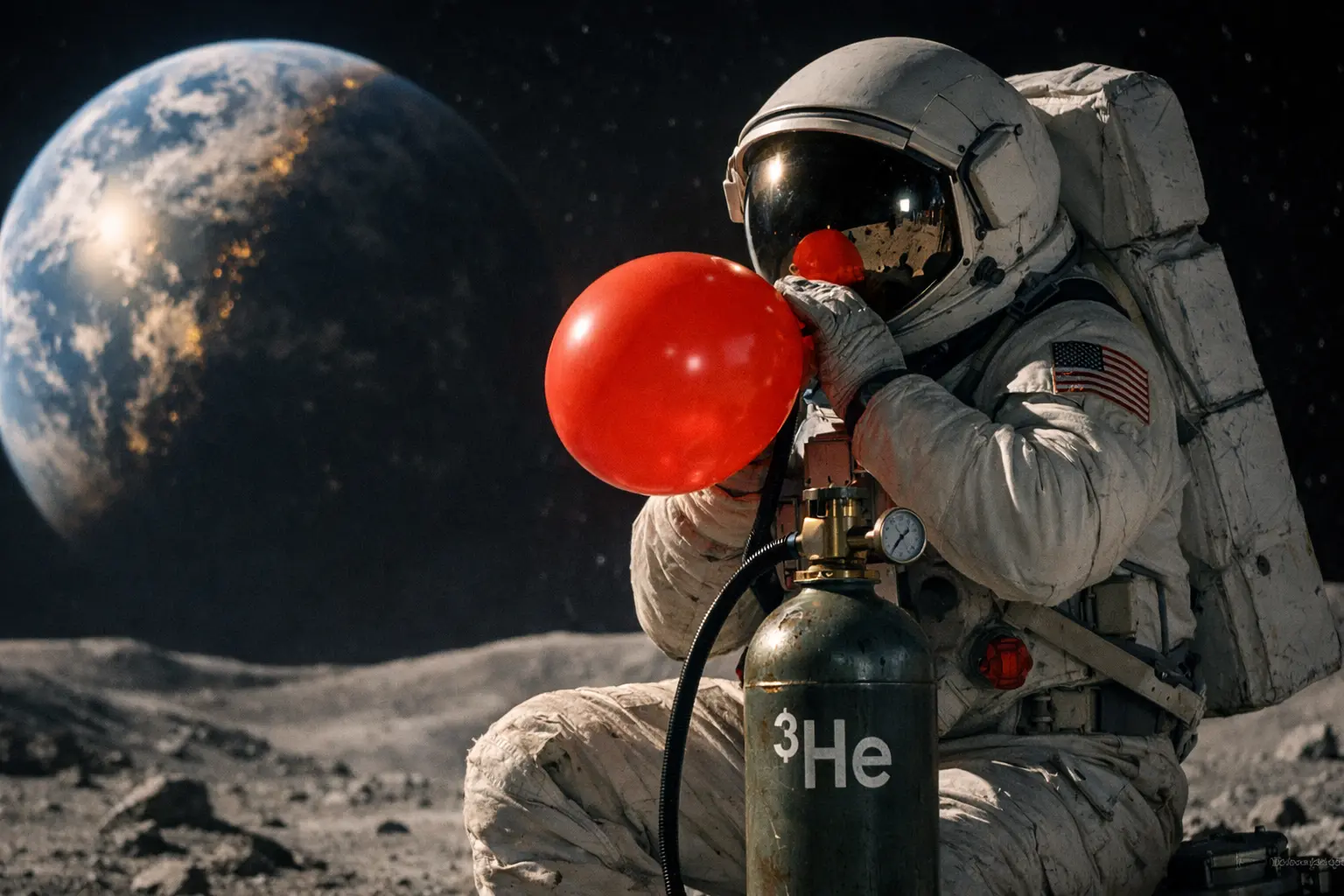
Duncan Jones’ 2009 film Moon turns an obscure isotope into a plausible MacGuffin: automated harvesters scooping lunar soil, extracting helium-3, and shipping it home to feed clean fusion reactors. It’s good sci-fi because it hangs on something real: helium-3 (³He) really is present in lunar regolith, and it really is interesting for fusion. The part that gets… cinematic is the implied timescale and ease.
What helium-3 is, and why it’s rare on Earth
Helium has two stable isotopes: the common helium-4 and the much rarer helium-3. On Earth, helium-3 is not something you “mine” in any serious quantity; historically, the main supply has come from tritium decaying into helium-3 inside nuclear weapons programs and related stockpiles. That dependence is one reason a widely discussed helium-3 shortage emerged around 2008–2009, impacting neutron detection and cryogenics.
On the Moon, the story is different. There’s no global magnetic field and essentially no atmosphere, so the solar wind can implant ions directly into the top layers of the soil. Over geological time, that leaves trace amounts of helium-3 trapped in the regolith grains.
How helium-3 fusion would work (in principle)
When people say “helium-3 fusion,” they usually mean the deuterium–helium-3 reaction:
D + ³He → ⁴He + p + 18.3 MeV
That “p” is a proton, and the key feature is that most of the energy ends up in charged particles (the helium-4 nucleus and the proton), not in neutrons. This is why you’ll often see helium-3 called “aneutronic-ish”: fewer neutrons means less material activation and potentially easier maintenance.
Because the products are charged, there’s also a tantalizing engineering idea: instead of using the fusion heat to boil water and drive turbines, you might convert particle energy more directly into electricity using electrostatic or traveling-wave “direct energy conversion” concepts. This is real research, but it’s still very much in the “advanced reactor” bucket.
A quick sanity check on the energy density: 18.3 MeV per reaction is enormous on a per-particle basis. If you could fuse 1 kg of helium-3 with the required deuterium, you’d release on the order of 6×10¹⁴ joules, roughly 160 GWh of energy. That sounds like magic—until you ask what it takes to run the reactor, contain the plasma, and obtain the fuel.
The catch: helium-3 fusion is harder than the fusion we’re already struggling with
The fusion industry’s “nearest hill” is deuterium–tritium (D-T) fusion, because it has the highest reaction rates at comparatively lower plasma temperatures. Helium-3 is, by comparison, an advanced fuel: you typically need higher operating temperatures and stronger confinement to get useful power out.
And it’s not perfectly neutron-free. In a hot D-³He plasma, parasitic D-D reactions happen too, producing some neutrons. Good designs can reduce that fraction, but the dream of “no shielding, no activation” is oversold.
So even if the Moon handed us helium-3 for free, the question would remain: do we actually have reactors ready to burn it economically? Not today.
The Moon as a fuel depot: “large total” vs “tiny concentration”
Here’s the other reality check: helium-3 on the Moon is diffuse. Measurements and mission analyses commonly talk about concentrations around tens of parts per billion in some mare soils—numbers like ~20 ppb show up repeatedly.
At 20 ppb by mass, you’re looking at roughly 20 milligrams of helium-3 per metric ton of regolith. That means:
- ~50,000 tons of soil processed per kilogram of helium-3
- ~50 million tons per metric ton of helium-3
And because helium-3 is trapped in grains, extraction concepts generally involve heating regolith to drive off volatiles, then separating tiny fractions of gases—on industrial scales, in abrasive dust, in vacuum, with extreme temperature cycling. NASA-linked concept studies model exactly these kinds of heat-and-capture workflows, and the numbers are sobering.
Yes, the total amount of helium-3 across the Moon could be large in an absolute sense, depending on assumptions about depth and concentration. But “large” doesn’t automatically translate to “practically recoverable at energy-system scale.”
So, can helium-3 secure our energy supply?
If the question is “could helium-3 be a wonderful fuel in a mature fusion era?” then: possibly. The reaction is attractive, and the reduced neutron fraction is a genuine advantage.
If the question is “does helium-3 from the Moon plausibly secure Earth’s energy supply any time soon?” then: very unlikely. You need two breakthroughs at once—economical helium-3-capable fusion and economical lunar industrial mining and return logistics—each of which is hard on its own.
A more grounded near-term story is that helium-3 already has high-value uses on Earth (cryogenics, some research applications), and that demand is visible enough that companies are pitching lunar helium-3 as a commercial product even without fusion—e.g., for ultra-cold systems in quantum computing.
That’s the best way to read Moon today: not as a roadmap, but as a parable about resource extraction and industrial scale. Helium-3 is real, the Moon does contain it, and helium-3 fusion is physically sound. The gap is not the isotope—it’s the engineering, economics, and timelines.