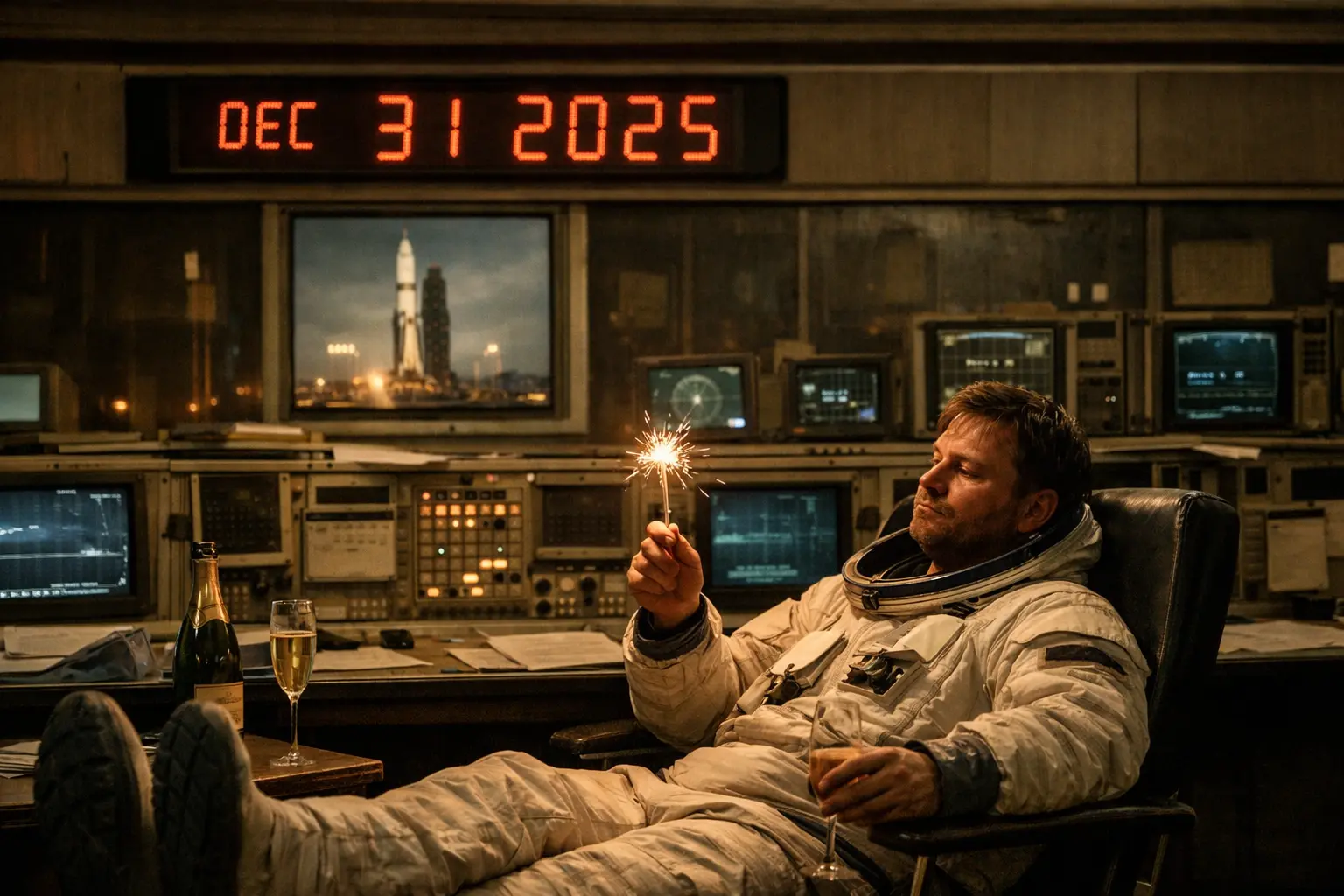
Space travel in 2025 didn’t feel like a single “breakthrough year” so much as a year when the boring parts of success became impossible to ignore. Rockets still launch. Spacecraft still work. But the system around them—traffic, infrastructure, regulation, and space weather—started to look like a set of constraints that can’t be waved away by another engine upgrade.
Start with the simplest metric: how many things are up there, and how often they have to dodge each other. ESA’s 2025 environment reporting puts the number of tracked objects at roughly 40,000, with about 11,000 active payloads. That’s the catalog you can track reliably; the smaller stuff is where the real “sandblasting” lives. What changed in 2025 is that collision avoidance stopped being an occasional operator chore and began resembling industrial routine. Starlink alone reported on the order of 144,000 conjunction risk mitigation maneuvers in a six-month span (December 2024 to May 2025), a number that would have sounded absurd not long ago.
This is not just about volume, it’s about coordination. A near miss reported in December—meters, not kilometers—between a Chinese satellite and a Starlink spacecraft turned into a public argument over who shared what tracking data, and when. A week later, another Starlink spacecraft suffered a violent anomaly that appears to have produced trackable debris fragments. Even if those fragments burn up soon, they still consume attention from the same surveillance and maneuvering ecosystem that everyone depends on.
The second 2025 constraint is less visible because it sits on the ground: communications and navigation infrastructure. NASA’s Office of Inspector General has described the Deep Space Network as operating at capacity and “oversubscribed,” with demand sometimes exceeding supply by as much as 40%. When the DSN is tight, it’s not just an inconvenience. It shapes mission design (how much data you can downlink), operations (how often you can talk to a probe), and ultimately the science return. It also becomes a schedule weapon: big campaigns—lunar, planetary, high-rate astronomy—crowd out the quieter missions.
Then there was space weather, which spent 2025 reminding everyone that “space” is not a vacuum in the metaphorical sense. NASA and NOAA publicly marked Solar Cycle 25 entering its maximum phase, and even as activity begins to trend downward, strong storms still show up. For operators, the practical problems are familiar: increased atmospheric drag changes LEO orbits, radiation affects electronics, and the forecasting uncertainties widen the margin that collision-avoidance systems must absorb. A recent modeling effort framed it in blunt terms: if satellites lose the ability to maneuver after a severe solar storm, collisions in LEO could start within days rather than months—an acceleration driven mainly by how crowded the neighborhood has become.
Against that background, the hard engineering problems of vehicles didn’t go away; they just stopped being the only story. Starship, for example, continued to move through a rapid test-and-fix loop, but 2025 also illustrated how development pace now has an airspace, maritime, and regulatory perimeter. The FAA expanded hazard areas and managed return-to-flight decisions even while investigations remained part of the landscape. “Move fast” still happens—just inside a growing choreography of risk controls that spans more than the launch site.
So what does 2026 look like?
Some of it is the obvious headline: human missions. Artemis II is now widely described as no earlier than February 2026, and its job is essentially systems validation—Orion’s life support, communications, navigation, and the procedural reality of sending a crew farther out than low Earth orbit. Boeing’s Starliner also sits squarely on the 2026 critical path, but not as a triumphant return; NASA and Boeing are targeting no earlier than April 2026 for an uncrewed Starliner-1 flight carrying cargo, explicitly framed as in-flight validation of upgrades and a step toward certification. These programs matter—but mainly because they consume shared resources (ISS planning, launch ranges, tracking, engineering attention) and because their risk posture tends to drag best practices into the rest of the sector.
The bigger 2026 challenge is operational governance: rules, data sharing, and scarce commons. Spectrum coordination is the quiet fight underneath satellite broadband, direct-to-device ambitions, and the next wave of constellations. The ITU has been pointing toward the need for international rules and mechanisms as constellation growth continues, and the political argument over “who governs what” is no longer an academic debate—it’s a bottleneck that shows up as interference disputes, filing races, and regulatory backlash.
Finally, 2026 will likely force a decision on whether space traffic management stays mostly voluntary and bilateral—or becomes something closer to civil aviation, with more standardized reporting and fewer opportunities to hide behind “we didn’t see it.” The numbers are already doing the persuading. When a single operator can rack up six figures of avoidance maneuvers in half a year, it’s a sign that the current approach scales badly.
If 2025 was the year space travel looked like a real transportation system—messy, crowded, infrastructure-bound—then 2026 is the year the industry gets tested on whether it can manage that system without waiting for a worst-case collision to write the rules for it.