Engineering design has long lagged behind the rapid pace of software development. While software can be updated in weeks, designing a new engine or complex machine often takes years. This discrepancy raises a question: why can’t engineering iterate as fast as coding? The team at Leap71 — a Dubai-based computational engineering startup — believes it can, by fundamentally rethinking how we design machines. Their proprietary software platform Noyron is an ambitious attempt to encode engineering knowledge into a computational model. The goal is to generate functional hardware designs autonomously in a fraction of the usual time, bridging the gap between an engineer’s intent and a manufacturable machine. In essence, Noyron has been called “the first AI that builds machines”, though it differs markedly from what we typically think of as AI.
Beyond CAD: What Exactly Is Noyron?
Conventional Computer-Aided Design (CAD) tools are essentially sophisticated drawing programs – they capture geometry, but not the rationale or physics behind a design. In contrast, Noyron is a Computational Engineering Model that encodes expert domain knowledge, physical laws (e.g. thermal and fluid dynamics), manufacturing rules, and other constraints into one coherent software framework. Instead of an engineer sketching a solution and keeping the logic “in their head,” Noyron’s model contains the logic. Given a set of input requirements, Noyron algorithmically synthesizes a design that should meet those specs — complete with geometry and even the manufacturing instructions to build it. This includes predicting how the design will perform (mechanically, thermally, etc.) before anything is built.
In practical terms, Noyron works like a digital engineer. It generates a design, checks it against physics and manufacturing constraints at each step, and iterates until the design meets the desired performance. The output isn’t just a CAD file; it’s a rich dataset: 3D geometry, ready-to-print files (like 3D printer toolpaths), bill-of-materials data, and predicted performance metrics. All of this is produced automatically. Like a human, Noyron even learns from experience — real-world test data and feedback are fed back into the model to continually improve its accuracy. Over time, as Leap71 tackles new problems, Noyron “grows in capability” with each insight gained from designing and building complex machinery.
Crucially, Noyron is not a big mystical neural network dreaming up designs from big data. It’s deliberately engineered as a deterministic, explainable system built on first principles. Every rule or assumption in Noyron is explicit and grounded in physics or expert knowledge. This means given the same inputs, Noyron will always produce the same result. It doesn’t “hallucinate” or output random surprises as some AI models might. Instead, it’s more like an extremely diligent junior engineer who has digested countless textbooks and design rules, and never forgets a detail. This rigorous approach — encoding only what is verified and logical — sets Noyron apart from the trial-and-error, black-box nature often associated with AI. In fact, Leap71’s founders argue that such a computational model is a prerequisite for true AI in engineering: you need a knowledge-rich, physics-based foundation before any machine-learning can meaningfully contribute. In short, Noyron is AI-driven in a sense, but it’s engineering AI done in a transparent, physics-first way rather than via inscrutable deep learning.
From Code to Fire: Rocket Engines Designed Autonomously
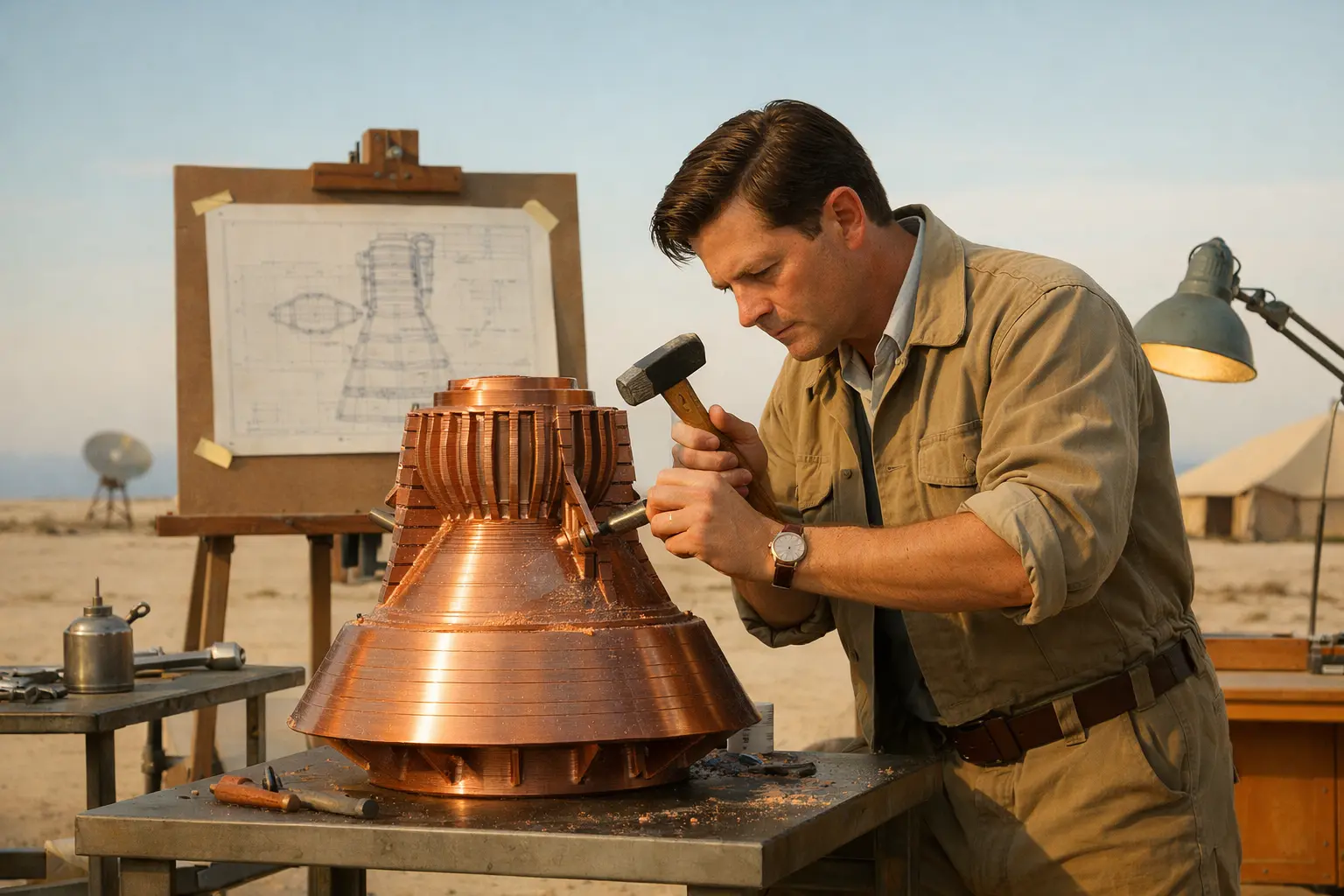
One of the most dramatic demonstrations of Noyron’s capabilities is in the realm of rocket engines. Traditionally, designing a new rocket engine — with all its complex turbomachinery, pumps, and cooling channels — is a multi-year endeavor. Noyron is turning this process on its head. In late 2025, Leap71 announced that in under three weeks from initial specifications to “first flame,” two different 20 kN rocket engines were designed entirely by Noyron and successfully hot-fired. To appreciate this: the software took a high-level spec for an engine and output full detailed designs for two variants (one a conventional bell-nozzle engine, the other an aerospike engine), which were then 3D-printed and test-fired without any human design tweaking. Both engines worked on the first try. Each produced about 2 tons of thrust (suitable for small orbital launchers), and their test firing provided real-world data that in turn will help refine the next Noyron iterations.
What’s striking is that Noyron isn’t just designing the outer shape of a rocket engine; it’s designing the entire propulsion system, including the intricate turbomachinery (like turbo-pumps and gas turbines that drive the propellant flow) and internal cooling channels. These are subsystems that typically demand highly specialized engineering. By incorporating these elements into its computational model, Noyron can output engines that are not only geometrically complex but functionally complete. In fact, Leap71’s new 2 meganewton (2,000 kN) engine designs – currently in development – come out of the software as single, monolithic structures that include components which would normally be separate parts. Thanks to advanced metal 3D printing, those designs can be built in one piece, eliminating the need to assemble dozens of parts and thus reducing potential points of failure. This synergy between physics-informed generative design and large-format additive manufacturing allows hardware to be created at scales and complexities previously impractical.
Of course, rockets push engineering to its limits, and not every nuance can be captured in software upfront. Leap71’s team emphasizes that practical testing remains crucial, especially for extreme elements like turbomachinery that involve high-speed rotating parts, thermal cycling, and precise sealing under pressure. Even so, the ability to iterate designs rapidly via software is a game-changer. Leap71 has been test-firing Noyron-generated rocket engines roughly every month – a pace unheard of in traditional engine development. Each test provides data (e.g. actual thrust, pressures, thermal behavior) which gets fed back to improve Noyron’s predictive accuracy. This closed loop means the software’s design logic becomes more robust with time, honing in on what actually works in reality. The recent 20 kN engine tests, for instance, validated Noyron’s physics models within a few percentage points of expected performance, boosting confidence that larger designs will also work as predicted. It’s a powerful virtuous cycle: compute → print → test → learn → (back to compute), compressing what used to take years into mere weeks or months.
While rocket propulsion is a headline-grabbing application (and indeed a focus for Leap71’s business), Noyron’s approach isn’t limited to engines. The software’s architecture is modular, allowing specialization for different domains. Leap71 has variants like Noyron RP tuned for rocket propulsion, Noyron HX for designing advanced heat exchangers, and Noyron EA for electric motors and electromagnetic actuators. In principle, any field where designs can be grounded in physics and expert rules could be fair game. For example, the company has showcased a hypersonic precooler (a device to rapidly chill air for high-speed flight) generated by Noyron’s algorithms. They’re also exploring things like novel electric drivetrains and robotic components. In all cases, the philosophy is the same: encode the know-how into software, generate designs quickly, and use modern fabrication techniques to bring them to life. It’s an approach that treats engineering like software development – iterative, data-driven, and fast.
Not Your Typical “AI”: Deterministic Design vs. Black-Box AI
Given these feats, one might be tempted to label Noyron as an “AI” that designs rockets. Indeed, Leap71 doesn’t shy away from the term completely – marketing has referred to Noyron as an AI-driven engineering system. But it’s important to understand how different Noyron is from the kind of AI that drives, say, self-driving cars or language chatbots. Rather than learning passively from big data, Noyron is actively taught by engineers. Its creators have painstakingly coded in the equations and logic from engineering textbooks, captured the “rules of thumb” that experienced designers use, and even integrated manufacturing constraints (like how thick a wall must be for a 3D printer to fabricate it) directly into the algorithms. As Leap71 co-founder Lin Kayser explained, Noyron’s codebase is written in a normal programming language (C#) and “explicitly encodes everything we’ve learned”. This makes the system transparent and explainable. Every design decision Noyron makes can, in theory, be traced and interrogated – unlike a neural net where reasoning is buried in millions of opaque parameters.
This stands in stark contrast to the popular image of AI as a mysterious deep-learning box. Noyron doesn’t rely on generic training data or probability; it relies on first-principles. The upside is that Noyron won’t unintentionally violate a law of physics or produce a nonsensical design – it literally can’t, because that would break its coded rules. The downside is that Noyron’s intelligence is narrow, extending only as far as its creators have built it. (But that scope is ever expanding as they add more knowledge.) In practice, Leap71’s strategy combines the best of both worlds: as their computational model handles the heavy lifting of generating and iterating designs, the human engineers can focus on expanding Noyron’s knowledge and validating results. It’s a collaborative vision of AI in engineering – more J.A.R.V.I.S. (Tony Stark’s smart assistant) than a magical “design button”. The human asks, “Can we try a larger nozzle here?” and the system adapts the design accordingly, flagging if something violates constraints. This conversational, cooperative AI paradigm may well define how complex machines are designed in the future.
Another key difference: Noyron’s outputs are production-ready by design. Because it understands manufacturing processes, it doesn’t produce blue-sky sketches that look cool but can’t be built. It generates practical, buildable solutions, often optimized for additive manufacturing from the start. This is a significant break from typical generative design software or AI, which might create organic-looking shapes but still leave engineers a huge post-processing task to actually realize the design. Noyron goes further – even generating the G-code toolpaths for printers or machining, when needed. In short, it’s not just design automation, it’s end-to-end engineering automation.
The Leap71 Vision (and a Nod to Dubai’s Role)
Leap71 was founded in 2023 by aerospace engineer Josefine Lissner and tech entrepreneur Lin Kayser, who set out with a bold vision: to radically accelerate real-world engineering and “shape the future of humankind” by making hardware development as fast and fluid as software. It’s the kind of audacious goal that requires equally audacious support. Perhaps unsurprisingly, Leap71 is based in Dubai, UAE – a region keen to establish itself as a hub for advanced technology and space innovation. (One might quip that ventures like this need petrodollar-levels of funding, and Dubai provides exactly that.) In fact, Leap71 has partnered with UAE’s space initiatives (such as a project with Aspire Space for a reusable spacecraft engine) and was featured at the Dubai Airshow, signaling strong local backing. The choice of Dubai is no accident: the UAE has been investing heavily in next-generation aerospace and AI-driven tech, giving companies like Leap71 a launchpad (both figuratively and literally) for their moonshot projects. It’s a reminder that revolutionizing an industry often takes not just brains and code, but also capital and confidence from stakeholders willing to bet on the future. In Dubai, Leap71 found an ecosystem eager to make such bets.
Looking ahead, Leap71’s Noyron and the computational engineering approach hint at a larger transformation in how we bring ideas into reality. Instead of drawing machines, tomorrow’s engineers might program them. The next generation of rockets, engines, and even everyday devices could be “computed” designs, evolved rapidly through software simulations and then birthed via 3D printers or automated factories. This approach doesn’t eliminate the engineer; rather, it elevates the role. Engineers become teachers and curators of the knowledge that systems like Noyron use, and stewards of the real-world testing that keeps those systems honest. Given the early successes — like 3D-printed rocket engines going from digital model to hot-fire in weeks — it’s clear this is more than a theoretical ideal. It’s already happening, and it’s likely to accelerate.
For interested tech readers and engineers, Noyron’s story is both a case study and a catalyst for discussion. It shows that by combining computational power with deep engineering expertise, we can unlock design possibilities beyond the limits of human patience or intuition. It also challenges us to rethink the tools we use: perhaps it’s time to retire some of our 40-year-old engineering “computers” (to paraphrase a thought experiment: we’d scoff at using a 1980s PC, so why accept 1980s-paced engineering?). The advent of computational engineering models like Noyron suggests that the slow, manual grind of design can give way to a new paradigm where speed and complexity are not enemies but allies. And as we compute ever more intricate machines — from rockets to reactors to robots — we may find that the boundary between what is designed by humans and what is designed by AI becomes delightfully blurred, without losing the rigor and creativity that true engineering demands.