Before astronauts could leave their mark on a spacecraft, they had to secure a decent view out of it. In the Mercury programme, pilots helped push capsule design beyond small portholes towards a proper window. Changing their job title had not extinguished the wish to see where they were going. Eagle inherited that practical concern. Its designers reduced large early windows to small triangular ones, bringing the standing astronauts close enough to the glass to preserve a useful view while saving weight. NASA: Mercury, NASA: Lunar Module
Looking at the spacecraft now, one is tempted to suggest another requirement: somewhere to stick a few Post-it notes. The familiar yellow squares were still years away; their nationwide American launch came in 1980. But the need they would serve was already aboard Apollo 11. Even on the way to the Moon, people needed to write things down. Post-it history
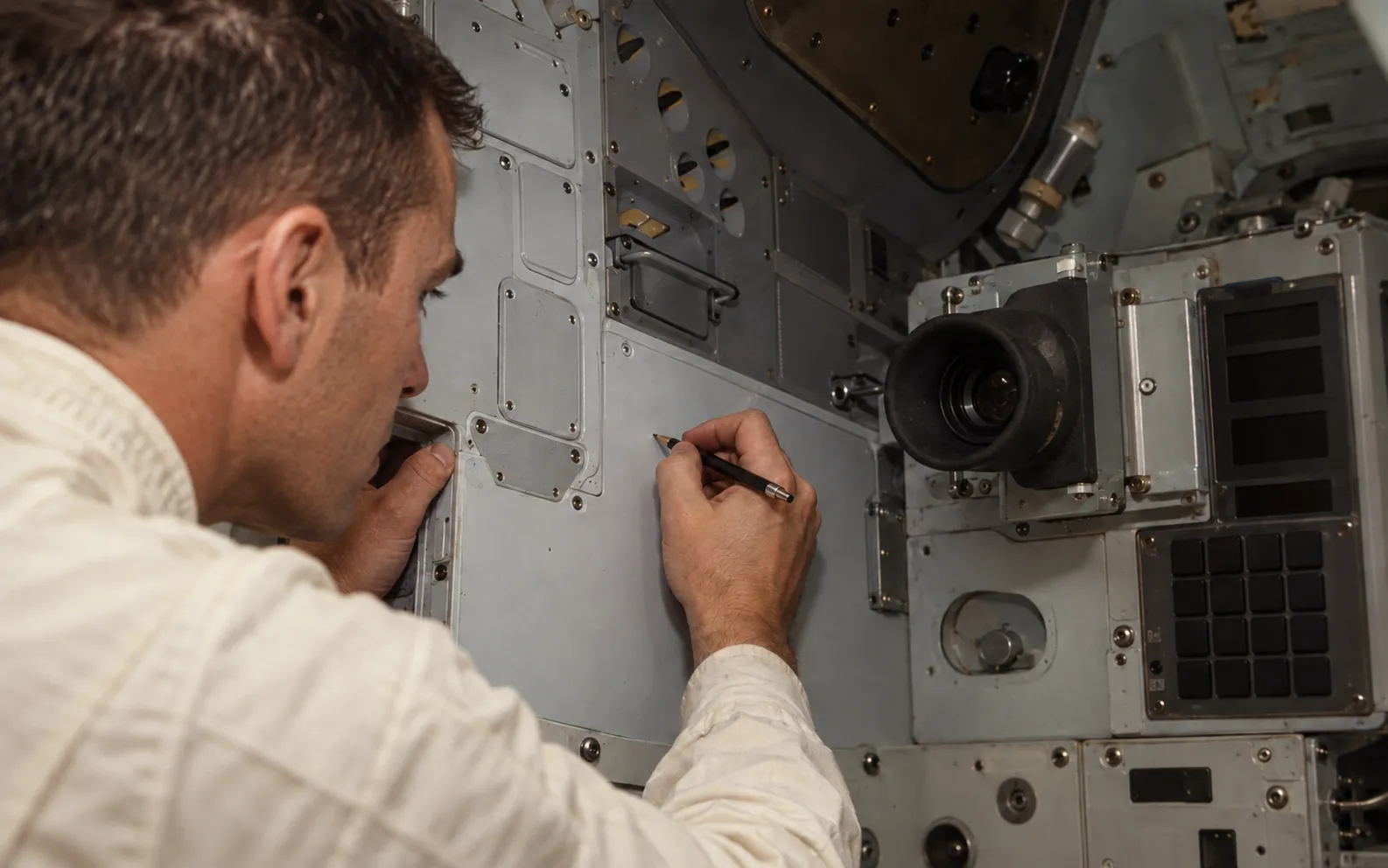
NASA had, of course, provided paper. The astronauts carried flight plans, checklists and spaces for recording information. Yet an approved document is not always the most convenient surface when a voice is reading out numbers and the place where you need them is directly in front of you. Inside Columbia, the command module, the spacecraft itself became part of the notebook.
During the Smithsonian’s work to create a detailed digital model of Columbia, researchers examined handwriting in areas long hidden from public view. Findings announced in 2016 brought renewed attention to the cabin as a place where three men had worked and lived. Numbers on a panel could be compared with radio transcripts. The interior preserved fragments of the mission’s daily activity alongside its instruments. Smithsonian
Some entries recorded coordinates supplied by Houston as Michael Collins tried to locate Eagle on the lunar surface. Alone in orbit, he searched below with Columbia’s optics, unsuccessfully. Those figures give the familiar story of the solitary third astronaut a more specific texture: listening, recording, checking, looking again. A museum visitor sees a historic spacecraft. The handwriting lets us glimpse a desk in use. Smithsonian
Other inscriptions concern matters less likely to appear in a commemorative speech. A locker was labelled “SMELLY WASTE”. Another identified urine bags from launch day, with the names Buzz and Mike; Mike’s name was subsequently crossed out. The grandeur of the destination had done nothing to remove the administrative demands of three human bodies sharing a small cabin. Someone still needed to know what was in the cupboard. Apollo Flight Journal
There was also a small calendar, with the mission’s dates crossed off through July 23. July 24, the day of splashdown, remained uncrossed. It invites speculation about anticipation, routine and the distance from home, although the marks alone cannot settle those questions. What survives is the familiar act itself: giving time a visible shape, one day at a time. Smithsonian
Eagle left a different kind of handwritten record. Its cabin never returned to Earth for conservators to inspect. The surviving evidence travelled home in documents, including the Lunar Module Timeline Book used by Neil Armstrong and Buzz Aldrin. Positioned between them during the landing, it accumulated nearly 150 annotations and completion marks. Its printed instructions became a record of actions performed.
Among its entries are landing coordinates that Christie’s identifies as having been written by Aldrin shortly after touchdown. The moment has an appealing lack of ceremony. After reaching another world, there was still information to capture before the next task. A pen moved across a page, doing a job it might have done in an aircraft, a laboratory or an office. Christie’s: Timeline Book
Another surviving document, Eagle’s systems activation checklist, carries additions to the list of equipment transferred aboard: tissues, snacks, a monocular. These small amendments belong beside the navigation figures. Both show the crew keeping the written plan aligned with actual circumstances. They also complicate the joke about forgotten Post-its. Apollo’s planners understood the need for writing; the crews found further uses and further surfaces as they went. Sotheby’s: Activation Checklist
A similar impulse survives in an earthbound footnote. When the B-52 known as Wise Guy was brought out of desert storage in 2019, a handwritten message in its cockpit asked its custodians to take care of it until it was needed again. The bomber was being revived, not scrapped. Its note expressed a personal attachment that an inventory entry could scarcely convey. US Air Force
Collins had left something comparable in Columbia. After splashdown, aboard the recovery carrier USS Hornet, he returned to the capsule and wrote a tribute calling it the best ship to come down the line. That inscription was known long before the Smithsonian’s scanning project. It belongs to a different moment from the hurried numbers: the work was finished, and he wanted to acknowledge the machine that had brought them home. Apollo Flight Journal
Together, these marks suggest how thoroughly people inhabit the tools entrusted to them. They add reminders, amend instructions, label inconvenient contents and occasionally offer thanks. Such writing can begin with almost no thought of an audience. Decades later, it gives an audience something the polished exterior cannot: evidence of particular hands attending to particular needs.
The windows let the astronauts look out. The handwriting now lets us look in. And perhaps the absence of those little yellow squares was fortunate for everyone who came afterwards. A removable note might have disappeared during the clearing of a cabin. Written directly on Columbia, an ordinary reminder remained attached to an extraordinary journey.
No comments yet