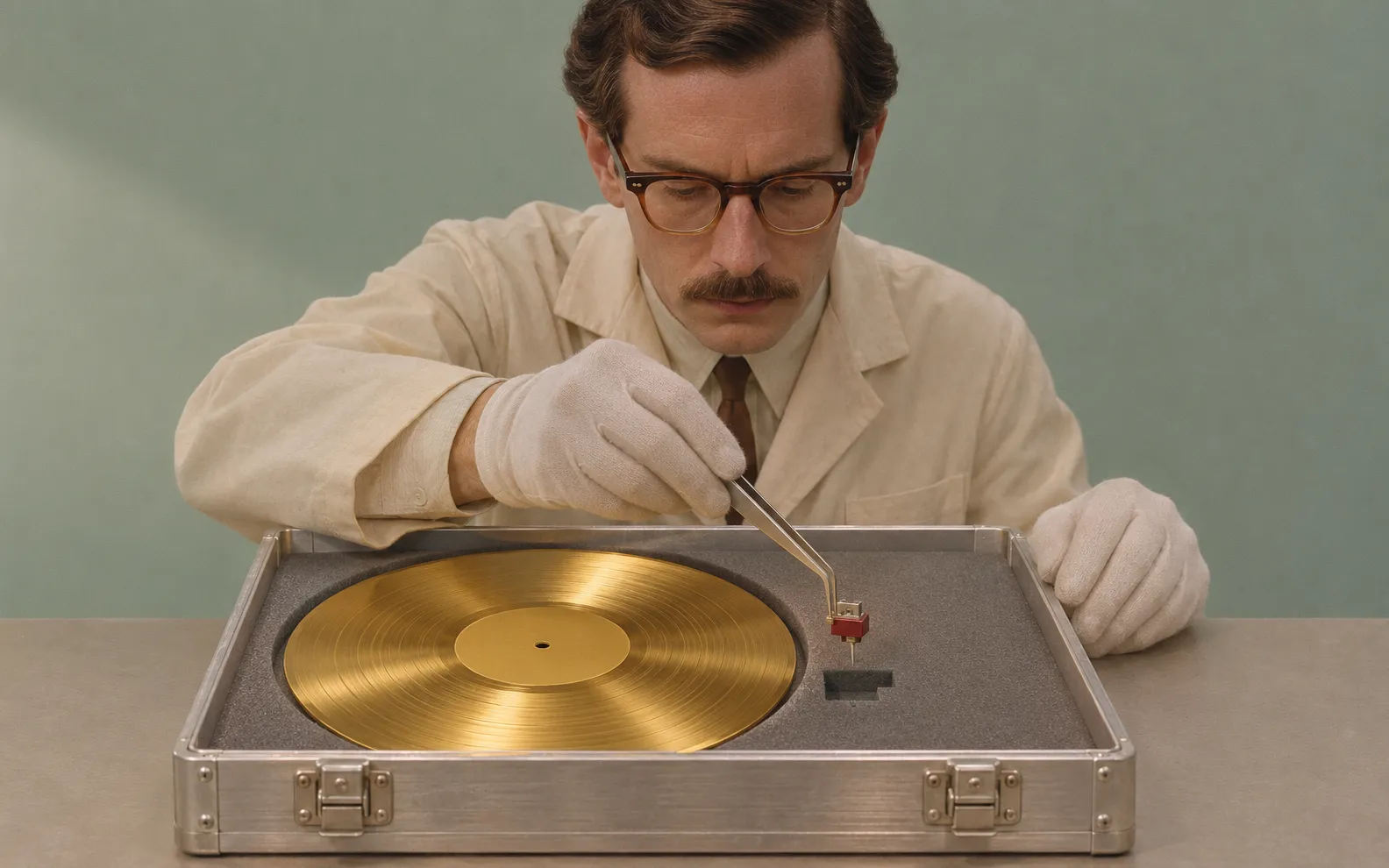
Somebody remembered to pack a needle. When NASA sent Voyager 1 off in September 1977 with a gold-plated record for any passing extraterrestrial, it included a cartridge and stylus. Somebody also thought about what might happen if the finder put the record on at the wrong speed. The cover gives the length of one revolution in units derived from the hydrogen atom. This is a fairly roundabout way of saying sixteen and two-thirds rpm, but it does spare an alien the embarrassment of playing Chuck Berry twice as fast and concluding that Earth was inhabited by exceptionally nimble mammals.
I have been thinking about that needle since November 18, when Voyager became the first thing we have made to get one light-day from Earth. The occasion brought out the large numbers, as such occasions do. For my money, the needle conveys the distance better than 25.9 billion kilometres. At some point in packing for this trip, a perfectly sensible person had to consider the possibility that the nearest shop would be here.
We had also asked the traveller to write home, and for years the postcards were magnificent. Jupiter in 1979. Saturn in 1980, its rings throwing shadows, its night side lit by light reflected off the rings themselves. On Valentine’s Day in 1990 Voyager turned the camera our way. Earth occupied less than a pixel. Thirty-four minutes after taking our picture, Voyager switched off its cameras for good. The family portrait took until May to finish arriving. Imagine taking a photograph in February, dismantling the darkroom, and trusting the post with the only copy.
The correspondence grew more interesting as it grew less picturesque. In 2012 Voyager crossed the heliopause, the boundary of the bubble blown by the solar wind. The instrument that might have settled the question directly had broken down back in 1980. Fortunately the Sun had sent something after Voyager. A solar eruption drove a disturbance out into interstellar space, setting electrons oscillating in the thin gas around the spacecraft. In 2013 its plasma wave instrument picked up the vibrations. Their pitch told scientists how densely the electrons were packed. The old neighbourhood had supplied the evidence that Voyager had moved out.
That instrument and the magnetometer, which measures the strength and direction of the local magnetic field, are the two science instruments Voyager 1 had left on duty before the present trouble. The cosmic ray instrument was switched off in 2025. The experiment that counted low-energy charged particles followed in April this year, with one small concession. Engineers left its little motor running. The motor turns the sensor through a circle so it can sample particles from different directions. Half a watt seemed a fair price to keep open the possibility of starting the instrument again someday. Even at the edge of the family budget, somebody can make a case for keeping the turntable.
Half a watt merits a meeting out there. Voyager makes electricity from the heat of decaying plutonium, and each year it has about four fewer watts to spend. In September engineers switched three devices off and three less power-hungry ones on, all together. The choreography mattered because electrical equipment also keeps its surroundings warm. Save power in the wrong place and a fuel line can freeze. The team called this manoeuvre the Big Bang, a splendidly immodest name for getting the heating bill down.
So how is Voyager? On November 14 an antenna near Canberra picked up its radio carrier. The science readings and the engineering reports normally carried on it were missing. The carrier itself tells us quite a bit. Voyager can still point its dish at Earth and its transmitter can still reach us. Engineers suspect the computer that gathers the readings and packages them for transmission. As of November 25, NASA has announced neither a diagnosis nor a return of readable data. Even a perfectly healthy magnetometer would have trouble establishing that fact through a colleague who has mislaid the envelopes.
There is precedent. On November 14, 2023, three years to the day before this latest trouble, Voyager stopped sending intelligible reports. A faulty memory chip turned out to contain some of the program responsible for preparing them. The surviving memory had enough room in total, although no single free stretch was big enough. Engineers divided the code, found homes for the pieces and fixed the references between them. In April 2024 the first engineering report came back. One can admire this repair on purely technical grounds and still feel that the coincidence of dates warrants giving Voyager next November 14 off.
On November 19 the carrier reached Earth from a day away. Together with the calculated trajectory, it gave NASA what it needed to confirm the crossing. Anyone inclined to ring up and ask how the repairs are going might consider the working week. Ask on Monday, get through on Tuesday, hear back on Wednesday at the earliest. Discover that you asked the wrong question and it is practically Friday.
Somewhere on that machine Chuck Berry is still waiting for his first booking outside the solar system. The prospective listener has a needle, instructions and all the time in the world. Back here we have the considerably trickier end of the correspondence. We know the sender intimately. We know the address to astonishing precision. We would much like a few lines about the state of the electrics.


No comments yet