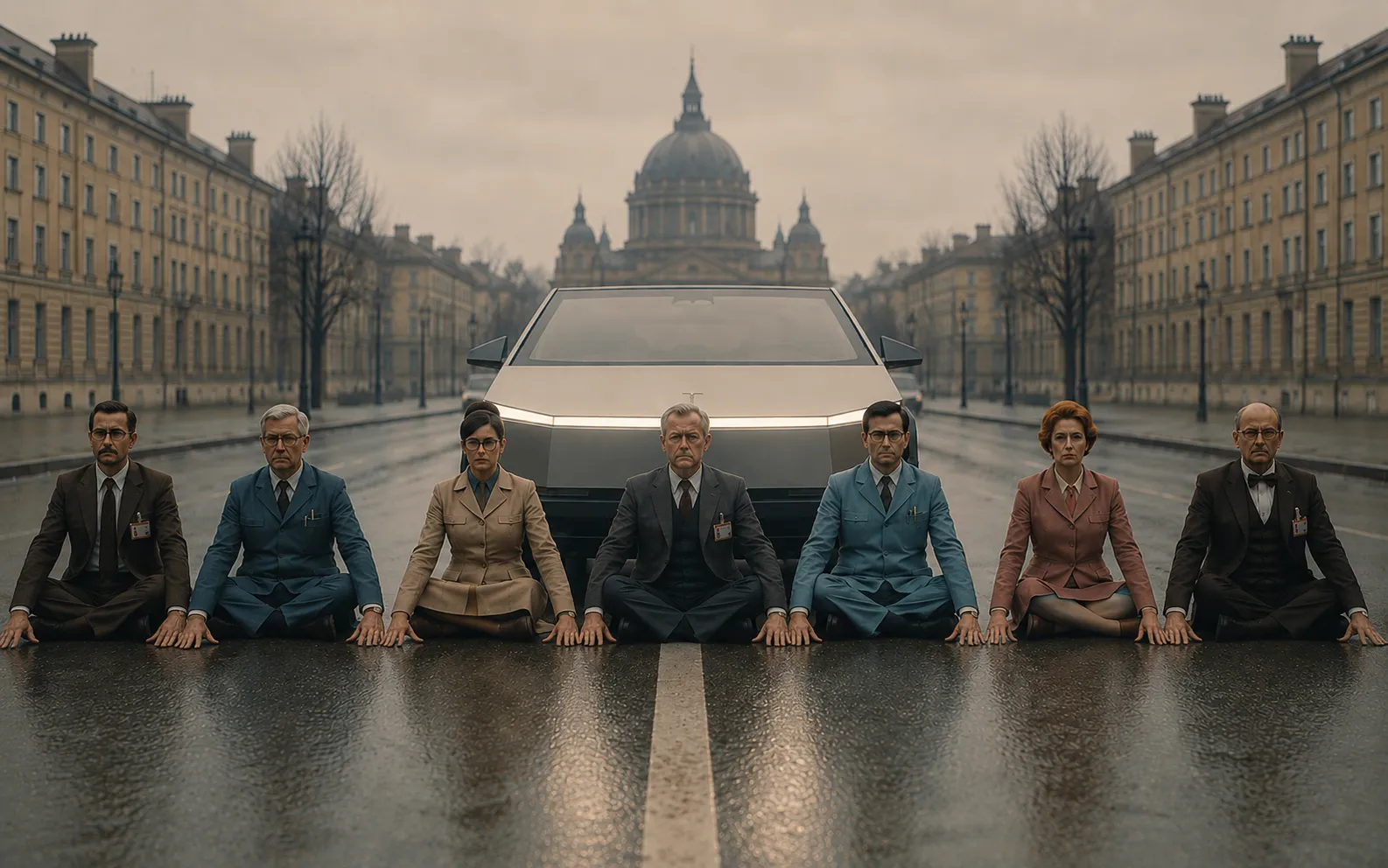
The first rule of modern European technology politics is simple: if you cannot build the future, appoint a committee to worry about it.
This was already visible in artificial intelligence, where “safety” has become the elegant word under which every institutional anxiety can be filed. Safety as engineering is necessary. Safety as a substitute for industrial capacity is theatre. Now the same reflex has rolled onto the road, wearing a fluorescent vest and carrying a clipboard. Tesla’s FSD Supervised is not only a question about software, driver monitoring, lane changes, liability, and type approval. It is also another small window into Europe’s strange new ambition: to become the world’s most respected spectator.
The European Transport Safety Council is lobbying EU transport ministers to resist the wider approval of Tesla FSD. That is its right. ETSC is an advocacy organisation. It exists to argue for road safety, to influence policy, to write letters, to raise alarms, and to insist that politicians take risks seriously. There is nothing improper about that. Civil society may lobby. Industry may lobby. Tesla may lobby. Safety groups may lobby. Everyone in Brussels is, in some refined form, lobbying someone about something.
But the important distinction is precisely the one that tends to disappear once the word “safety” enters the room. ETSC is not a type-approval authority. It does not carry the legal responsibility of approving a vehicle system. It does not run the certification framework. It does not have to weigh innovation, evidence, engineering trade-offs, user benefits, accident data, liability structures, and competitive consequences under a binding legal mandate. It advocates. That is a legitimate role. It is not the same role as deciding.
The Netherlands’ RDW, by contrast, is an approval authority. It says it examined Tesla’s FSD Supervised for more than a year and a half, on test tracks and public roads. It stresses that the system is not autonomous, that the driver remains responsible, and that driver monitoring is central to the approval. One may agree or disagree with RDW’s conclusion. One may ask whether its test methodology was sufficient, whether the evidence should be public, whether the name “Full Self-Driving” is still a marketing provocation in a regulatory trench coat. These are serious questions.
But seriousness is not the same as veto by press release.
The uncomfortable part is that both sides have a point. Tesla’s safety claims deserve skepticism. Self-published crash statistics are not a sacrament. Comparing modern, expensive, sensor-rich vehicles with the broad average of the aging vehicle fleet is not science; it is persuasion wearing a lab coat. If Tesla wants to make sweeping claims about lives saved, crashes prevented, and orders of magnitude in safety improvement, the data should be made available for independent analysis. A system that asks the public for trust should not hide behind marketing arithmetic.
At the same time, Europe must resist the opposite temptation: treating uncertainty itself as proof of danger and precaution as proof of wisdom. The fact that a technology is imperfect does not mean the correct response is delay until metaphysical certainty has been achieved. Human drivers are not a gold standard. They are distracted, tired, drunk, angry, old, inexperienced, overconfident, visually impaired, texting, arguing, eating, and occasionally convinced that physics will make an exception for them. Any serious assessment of driver assistance must compare risk against the actual road, not against an imaginary human who never looks at his phone and always checks the blind spot.
This is where the debate becomes revealing. The strongest case against FSD Supervised is not that machines make mistakes. Of course they do. The strongest case is that partially automated systems can create a dangerous ambiguity: the machine drives just well enough for the human to stop supervising it, but not well enough to be left alone. The driver becomes the emergency backup for a system that has slowly trained him to become unnecessary until the precise second he is desperately needed. That is a real human-factors problem. It should not be waved away by Tesla fans with dashboard videos and stock-ticker enthusiasm.
But if that is the problem, then the answer is better evidence, better testing, clearer liability, transparent performance reporting, and strict post-deployment monitoring. It is not a ritual in which an NGO, however sincere, becomes the moral proxy for technical authority. Nor is it a regulatory culture in which the burden of proof silently expands until deployment becomes impossible for everyone except yesterday’s systems.
Europe loves this posture because it feels like power. To say no is immediate. To demand another review is easy. To convene another closed meeting is respectable. To produce a position paper is institutionally satisfying. Building, by contrast, is vulgar. It requires failure, iteration, capital, litigation risk, user feedback, engineering compromises, and the possibility that someone somewhere will post a video of your system doing something stupid. The builder is always exposed. The watcher is always clean.
This is the deeper continuity with AI. Europe increasingly confuses supervision with sovereignty. It wants the authority of the maker without the discomfort of making. It wants to shape the rules of systems it did not invent, run on infrastructure it did not fund, using chips it did not fabricate, software platforms it did not dominate, and companies it often regards with a mixture of envy and suspicion. The result is not technological independence. It is dependence with procedural dignity.
FSD Supervised may or may not deserve EU-wide approval now. That should be decided through competent technical assessment, transparent criteria, independent data, and public accountability. Tesla should not be allowed to bulldoze Europe with selective statistics and fan pressure. But Europe should not allow safety NGOs, committees, or ministries of concern to turn technological evaluation into another morality play about restraint.
A mature civilisation can test dangerous things without becoming childish about danger. It can say: prove it, monitor it, publish the data, assign responsibility, punish deception, and still allow progress when the evidence supports it. That is not deregulation. That is adulthood.
The future will need road safety. It will need regulators. It will need independent critics. It will need people willing to say no when the evidence is poor.
But it will not be driven by people whose highest ambition is to stand at the kerb, clipboard in hand, watching others learn how to move.
No comments yet