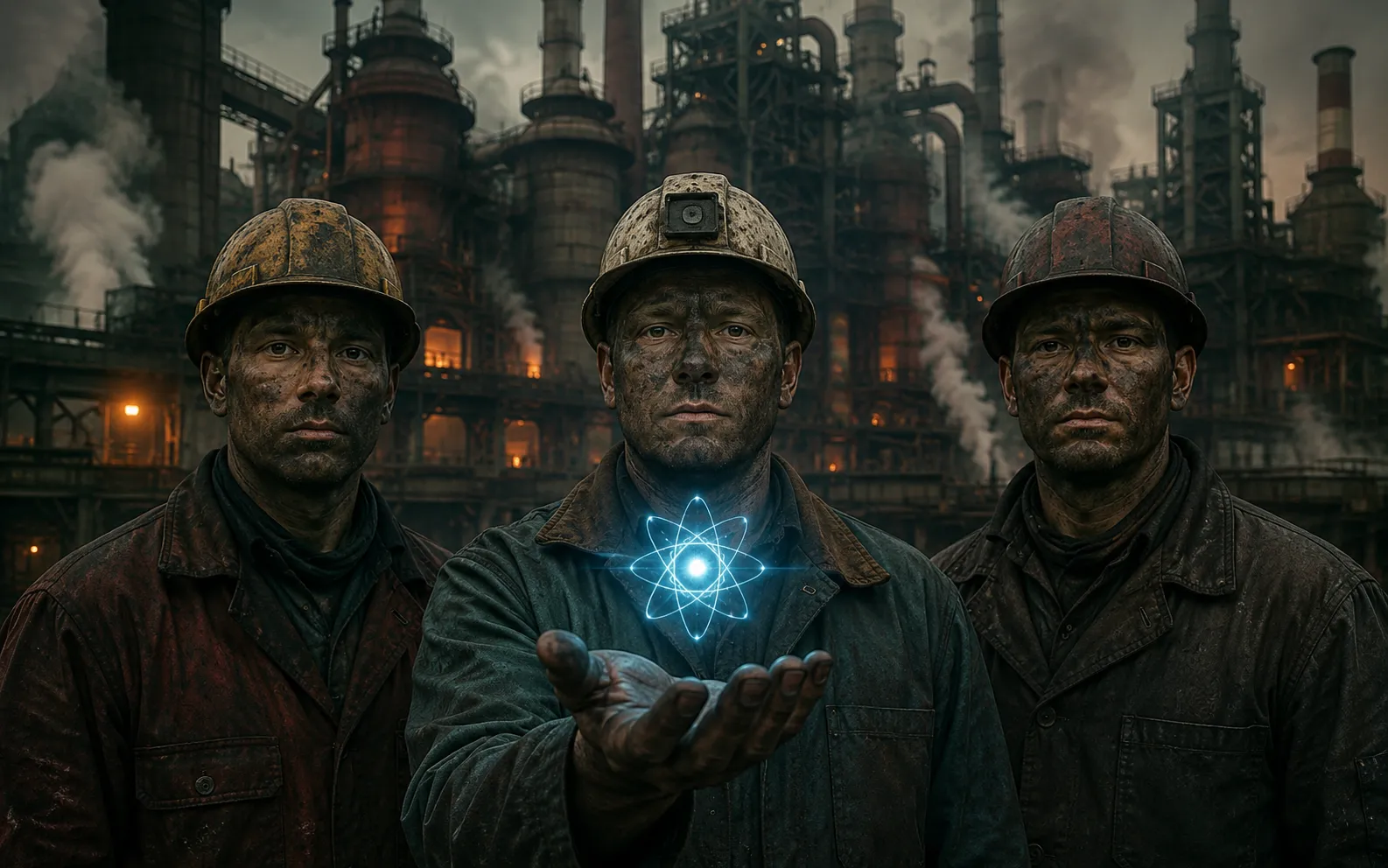
There are moments when a technology demonstration is more than a demonstration. It becomes a cultural mirror. Valar Atomics powering an Nvidia system with a small nuclear reactor is one of those moments. Not because it proves that every data center will soon have its own reactor humming behind the fence. That would be premature. But because it shows, almost theatrically, where the next industrial frontier is moving: toward dense, reliable, local, high-temperature energy for computation, manufacturing, hydrogen, synthetic fuels and whatever comes after the current AI boom.
Valar’s message is not merely “small nuclear is coming.” It is more radical than that. The company argues that nuclear has been trapped inside the old utility model: large bespoke plants, endless grid politics, decade-long licensing battles and one-off construction projects. Its proposed alternative is the “gigasite”: repeated reactors, co-located industry, heat used directly, electricity used locally, and customers that need energy density more than ideological approval. Their reactor architecture is based on high-temperature gas reactor principles, using TRISO fuel, graphite moderation and helium cooling. The important phrase is not only “nuclear power.” It is “reliable heat.”
That matters because much of the public energy debate still talks as if electricity were the whole story. It is not. Civilization runs on heat, movement, chemistry and computation. Steel, cement, ammonia, hydrogen, data centers, desalination and future space infrastructure all demand energy that is not merely clean on an annual spreadsheet, but available at the right temperature, in the right place, at the right time. Wind and solar are extraordinary technologies, and Germany has built them at impressive scale. But they are not the same thing as an always-on industrial power source.
The Nvidia connection makes this visible. Reuters reports that Valar and Nvidia are working on a Utah data center intended to conserve water by combining a microreactor with closed-loop liquid cooling. Other reporting describes a live demonstration in which Valar’s Ward 250 produced thermal power that was converted into electricity for an Nvidia system. Again: this is not yet commercial proof. It is a prototype, a signal, an argument made in hardware. But it is also a clear answer to a question Europe often prefers not to ask: where will the energy for the next industrial platform actually come from?
AI is the visible driver, but not the only one. Spaceflight, robotics, autonomous factories, synthetic fuels and advanced materials all converge on the same physical bottleneck. Intelligence without energy remains a screensaver. A nation can have brilliant engineers, universities, software talent and industrial memory, but if it treats dense energy as morally contaminated, it will eventually outsource the future to those who do not.
This is where Germany’s position becomes so difficult to watch. Germany closed its last three nuclear power plants on 15 April 2023. That decision was not a technical inevitability. It was a political and cultural decision, defended long after the strategic environment had changed. Germany had already lost cheap Russian gas as the silent foundation of its industrial model. It had an aging grid, high energy prices and an economy built on energy-intensive excellence. Yet it chose to remove firm low-carbon capacity from the system at precisely the moment when electrification, digital infrastructure and industrial resilience became more important.
The achievement of German renewables should not be mocked. In 2025, renewables supplied 55.9 percent of Germany’s net public electricity generation. Wind and solar are now central pillars of the system. That is real engineering, real capital and real operational progress. But it is also not the whole truth. Fraunhofer notes that fossil generation stagnated in 2025 because declining lignite output was offset by rising natural gas consumption. The International Energy Agency still describes German electricity prices as among the highest in Europe. A system can be green in ambition and still fragile in practice.
The tragedy is not that Germany invested in renewables. The tragedy is that it turned energy policy into a theology of exclusion. Instead of asking which combination of technologies produces abundant, clean and sovereign power, it defined one of the most energy-dense tools ever invented as outside the acceptable imagination. Coal could linger. Gas could return as backup. Industrial subsidies could be designed to soften the pain. But nuclear, the one source that combines high energy density, low operational emissions and firm output, had to be removed from the moral universe.
This is not prudence. It is a failure of strategic imagination.
Valar Atomics may fail. Many nuclear startups have failed before. Advanced reactors must still prove licensing, fuel supply, manufacturability, cost, maintenance, safety culture and public trust. No serious observer should confuse a dramatic demonstration with a finished industrial revolution. But the direction is unmistakable. The United States is trying to compress nuclear iteration cycles. Companies are connecting reactors to data centers, industrial heat and synthetic fuels. Investors are beginning to understand that AI is not only a software race, but an energy race. The winners will not be the countries with the purest slogans. They will be the countries that can build.
Germany still has time to think again. Not necessarily by pretending that the old plants can simply be resurrected, and not by replacing renewables with nuclear fantasy. The serious path is harder: admit the error, stop dismantling competence, re-enter European nuclear research, support advanced reactor licensing, rebuild the supply chain, and treat firm clean power as a national capability rather than a cultural taboo.
A spacefaring civilization cannot be powered by nostalgia. Nor can an industrial nation survive on symbolic purity. The future will need electrons, heat, fuel and computation in quantities that make today’s debates look provincial. Somewhere in Utah, a small reactor powering an Nvidia machine has made that future briefly visible.
Germany should look at it without flinching.

No comments yet