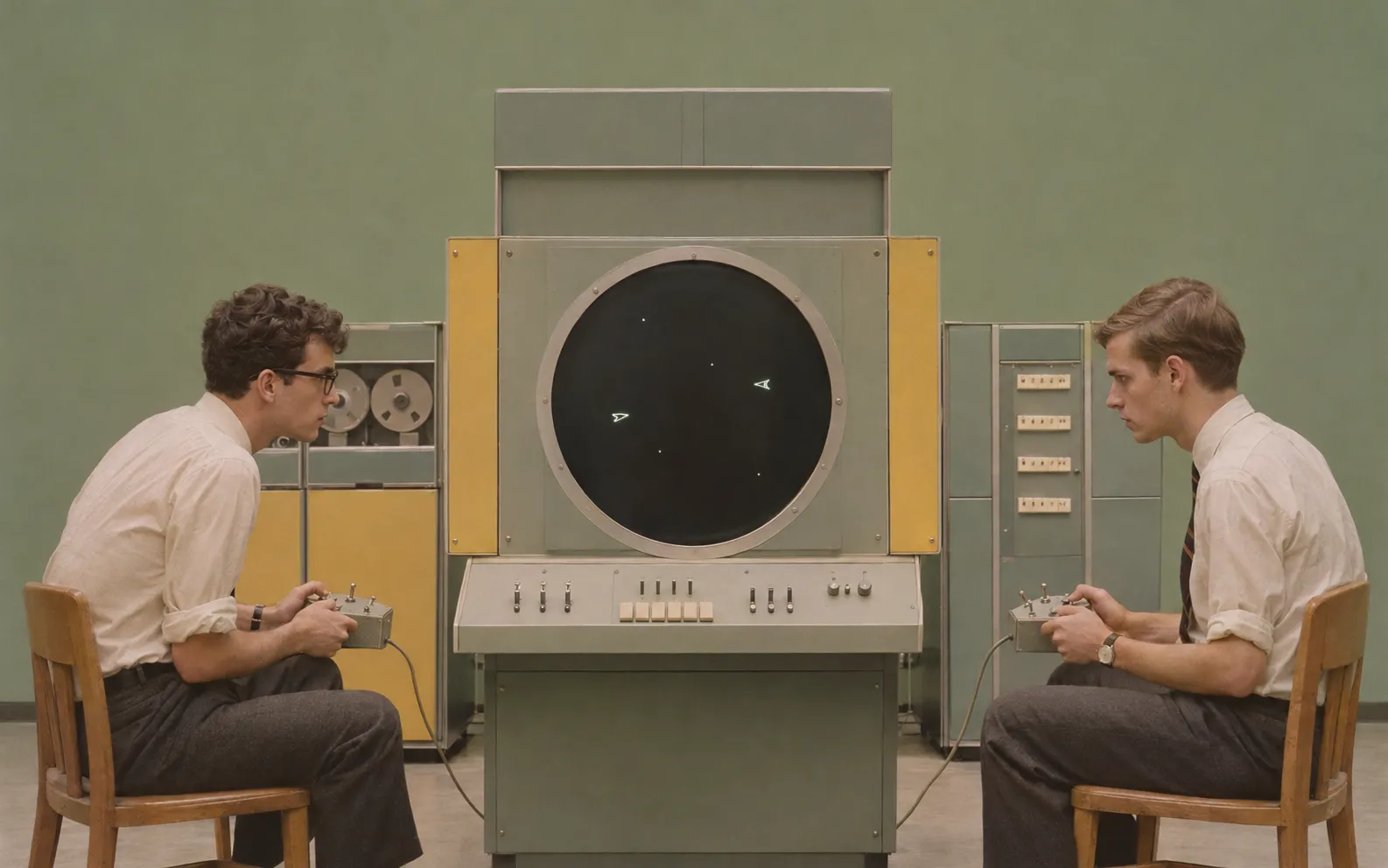
Before “hacker” became shorthand for somebody stealing your password, it could mean somebody looking at an expensive computer and deciding that it urgently needed spaceships.
I find this older definition considerably more attractive.
It also explains why I wish more people would discover The Part That Changed the World. Its video The 18-Bit Computer That Helped Start the Hacker Revolution revisits the PDP-1 and the people who saw possibilities inside it that no sensible purchasing committee would have put in the requirements.
Watching it, I felt that familiar mixture of delight and regret: delight that someone is telling this story, regret that stories like this attract so much less attention than whatever technological apocalypse we are being offered this afternoon.
I worked with Altair computers. Unfortunately, I never got my hands on a PDP-1. That remains a small personal grievance against the distribution of historical opportunities. Some people regret never seeing the Beatles. I have additional complaints involving computer hardware.
The PDP-1 arrived at MIT in 1961. Built by Digital Equipment Corporation, it worked with 18-bit words and offered something more consequential than its specifications: an invitation to interact. You could sit at the controls, try something and see what happened.
That mattered in a world where much computing involved submitting punched cards and waiting. Discovering a mistake could mean joining the queue again. Imagine debugging by post, with the computer maintaining the brisk conversational pace of a planning authority.
The PDP-1 helped make a different relationship possible. Computing could become an absorbing conversation, conducted through experiments.
Naturally, somebody wanted to shoot things.
Spacewar!, developed in 1962 by Steve Russell and his collaborators, put two spacecraft into combat on the machine’s display. It was among the earliest computer games, although earlier experiments elsewhere prevent it from honestly claiming to be the first. Its distinction lies partly in what happened around it: people played, improved, copied and adapted it.
The game became a gathering point for ingenuity.
Dan Edwards added a central star whose gravity affected the ships. Suddenly, movement involved more than pointing in the right direction. The universe had acquired an opinion about your tactics.
Peter Samson supplied a star field based on actual astronomical positions. This remains one of my favourite details in computing history. Here were people inventing space combat on a machine with extraordinarily limited memory, and somebody decided that the background astronomy needed to be accurate.
A lesser civilisation would have settled for decorative dots.
Alan Kotok and Bob Saunders built separate control boxes because playing with the computer’s console switches was awkward. The desire to play better produced another piece of invention. Nobody needed a presentation explaining that the interactive entertainment sector might offer strategic opportunities. Their hands were uncomfortable. They fixed it. Martin Graetz’s account preserves these beginnings.
These details matter because they reveal what the early hackers actually did.
Many belonged to the culture around MIT’s Tech Model Railroad Club, where elaborate wiring and control systems already offered endless opportunities for clever interventions. The club still insists on the constructive meaning of “hacker”: someone who uses ingenuity to achieve a clever result.
There is delight inside that definition. A hacker wants to understand the mechanism, discover its possibilities and make something work through skill, persistence and occasionally an unreasonable commitment to a minor detail.
The word carries the pleasure of doing.
That pleasure extended beyond games. Around the PDP-1, programmers developed tools for editing and debugging, and made the computer produce music. A machine built for serious work could become an instrument, a workshop, a playground. Each experiment made another possibility easier to imagine.
Spacewar! captures that spirit beautifully because play exposes the poverty of judging every experiment by its immediate usefulness. Two little ships pursuing each other might seem trivial. But making them move, respond and obey rules required people to explore what interaction could become.
And they shared the result.
The game’s circulation allowed others to learn from it and carry it into new settings. You can recognise an enduring strand of computing culture here: the satisfaction of making something interesting, then letting somebody else examine it and take it further.
This is the history I want beside today’s arguments about technology.
We discuss new tools as though the future arrives fully assembled, accompanied by a keynote and a subscription plan. Yet much of what feels inevitable began with somebody trying an odd idea on equipment intended for something else.
Understanding that journey changes how we look forward. We become better at recognising possibility while it still looks like a distraction.
Which brings me back to the video, and its disclosed use of AI.
I welcome it. If modern tools help someone tell these stories clearly and engagingly, that is a worthwhile use of modern tools. Research and accuracy still matter. So does giving a small creator the means to make an obscure subject accessible.
There is a pleasing continuity in using computers to explain why people once fell in love with using computers.
We can only appreciate the future properly if we understand the road that brought us here. Sometimes that road passes through a model railway club, a round display and a star field somebody insisted on getting right.
I never played Spacewar! on a PDP-1. But I recognise the curiosity behind it.
Before the forecasts, the fortunes and the frightened headlines, somebody sat down at a machine and wondered whether it could do something wonderful.
Then somebody else added gravity.

No comments yet