Look at their faces. Hundreds of people watching the same impossible thing become real. For a moment, the machinery almost becomes secondary. What holds your attention is the release: disbelief giving way to joy, the collective recognition that something they have worked toward actually happened. Behind every face is a private history of effort that the broadcast cannot show. We see the celebration. They know what it cost to get there.
Above them, Mechazilla catches a spaceship with chopsticks.
Mr. Miyagi once caught a fly that way. This fly is a little bigger.
On November 14, 2026, Ship 42 returned from orbit and was caught at Starbase. The sheer absurdity of that sentence deserves a moment. A spacecraft leaves Earth, travels around the planet, survives its return through the atmosphere, and comes home to a tower that reaches out and holds it. Science fiction has supplied us with countless spectacular departures. Here was something more intimate, and perhaps more consequential: an arrival.
Naturally, it had to be forty-two. Douglas Adams would have appreciated the number, and the words written on the vehicle: “Don't panic.” There is something wonderfully human about sending that instruction into space on an experimental machine. The universe offers plenty of reasons to panic. Engineering begins when people sit down anyway, calculate the forces, examine the failures, and decide what to try next.
There have been plenty of failures. Starship's first integrated flight in 2023 ended after engine failures and an uncontrolled tumble, with the flight termination system commanded. The road since has demanded repeated tests, revisions, and the willingness to expose unfinished work to the entire world. Every explosion becomes an instantly shareable image. The painstaking investigation afterward rarely attracts an equivalent audience. Failure gets a replay. Learning gets another shift at work.
That imbalance has fed the chorus of haters and naysayers. Some seemed to greet every setback with the satisfaction of people whose greatest investment was predicting that somebody else would fail. A wrecked vehicle became proof that the whole ambition was fraudulent. A missed deadline became evidence that the destination itself was imaginary. From the comfort of a comment box, the distance between “not yet” and “never” can disappear remarkably quickly.
Serious criticism deserves a better category. Engineers need scrutiny. Public safety matters. Costs and environmental consequences require honest accounting. None of that obliges anyone to pretend this catch was ordinary. Skepticism earns its credibility by responding to evidence, including evidence of success. When a spaceship returns from orbit and settles into waiting mechanical arms, an honest observer should be capable of changing their mind, or simply admitting that something extraordinary has happened.
The achievement also deserves an accurate description. The booster was lost on this flight; the hoped-for double catch did not happen. Recovering Ship 42 does not yet establish routine, inexpensive reuse. Inspection, refurbishment, and successful flights of recovered hardware will determine how far the economics can change. Those unfinished tasks belong in the story. They make the accomplishment tangible, with measurable next steps and real work still ahead.
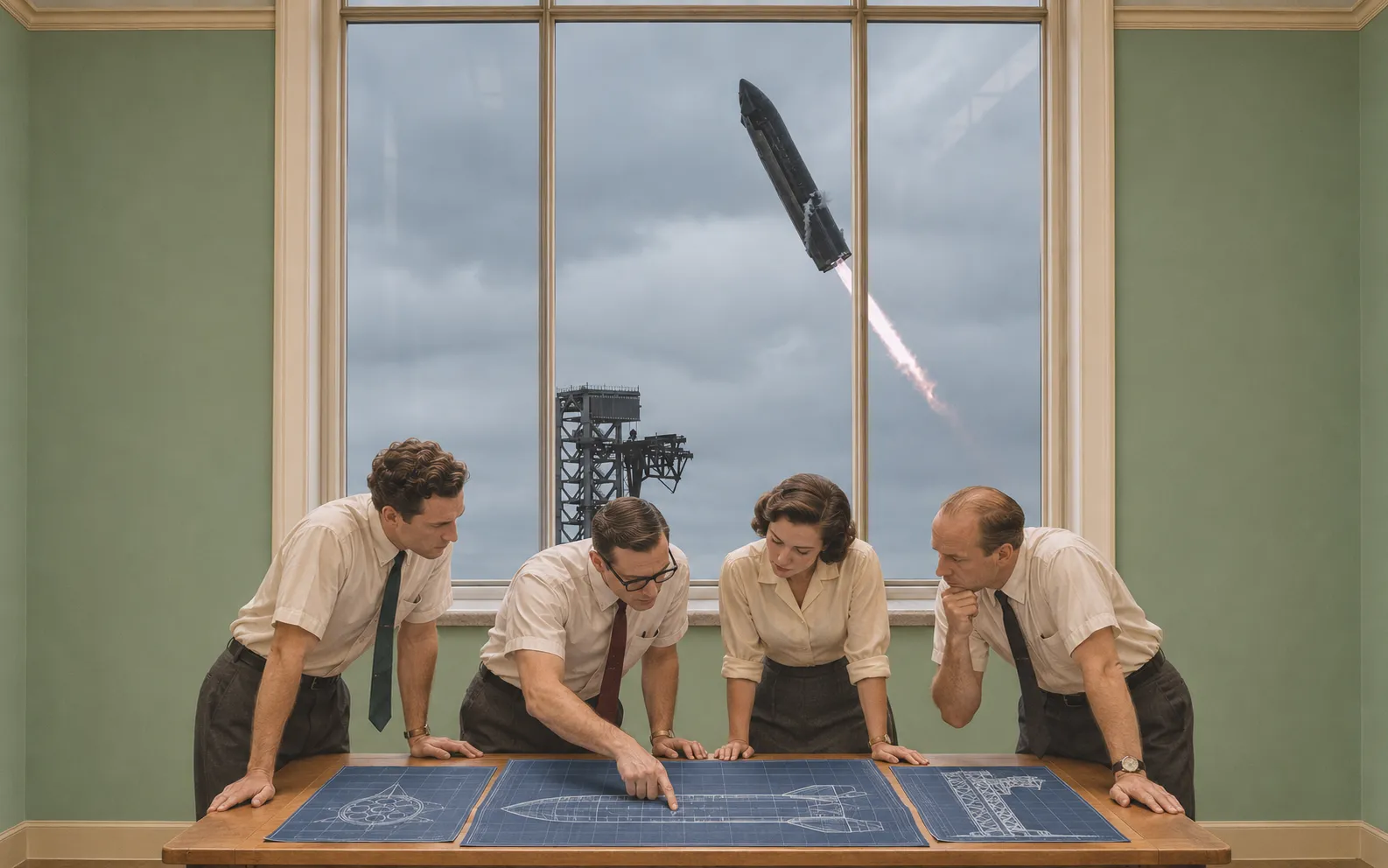
And the triumph is deserved. Think of the disciplines that must agree for those final seconds to work: propulsion, structures, software, guidance, thermal protection, ground equipment. Think of the people manufacturing parts, checking connections, questioning assumptions, finding the small discrepancy that could become a catastrophe. Elon Musk's ambition is central to this project, but those hundreds of faces remind us how ambition acquires physical form. People build it, together, through thousands of decisions nobody applauds.
For humanity, the possibility opened here is practical before it becomes philosophical. Spaceflight remains constrained by the difficulty and expense of transporting useful mass beyond Earth. If large vehicles can eventually fly repeatedly with limited servicing, more missions could become feasible. Bigger scientific instruments. More supplies. More opportunities to repair, construct, experiment, and stay. A lunar presence requires deliveries. A journey to Mars requires an immense logistical effort. Every vision eventually needs a transport system.
No single catch guarantees any of this. Yet it changes what can reasonably be imagined, because one formidable piece of the problem has now been demonstrated. That matters beyond aerospace. A society surrounded by reasons for resignation needs encounters with competent, collective effort. We need to see difficult things accomplished by people who accepted uncertainty without surrendering to it. Progress requires that patience, especially when the evidence arrives more slowly than the ridicule.
There is also a generosity in exploration that exceeds the company undertaking it. Children watching this moment may become engineers, scientists, or builders of things we cannot yet name. Others may simply recover a little appetite for the future. Earth remains our home and our responsibility. Learning to travel farther can deepen our understanding of that home while enlarging the range of human experience. Curiosity is among the better reasons to undertake something difficult.
So look again at the faces. Let the cheering have its moment. Tomorrow will bring inspections, uncomfortable findings, revised calculations, and another long list of problems. Today, people who carried an improbable idea through years of resistance watched a spaceship come back into their hands. The tower held the ship; the people below it could finally let go of their breath. They earned that joy. And everyone watching was allowed, for a few seconds, to share it.
Forty-two. Don't panic. There is work to do, and now another reason to believe we can do it.

No comments yet