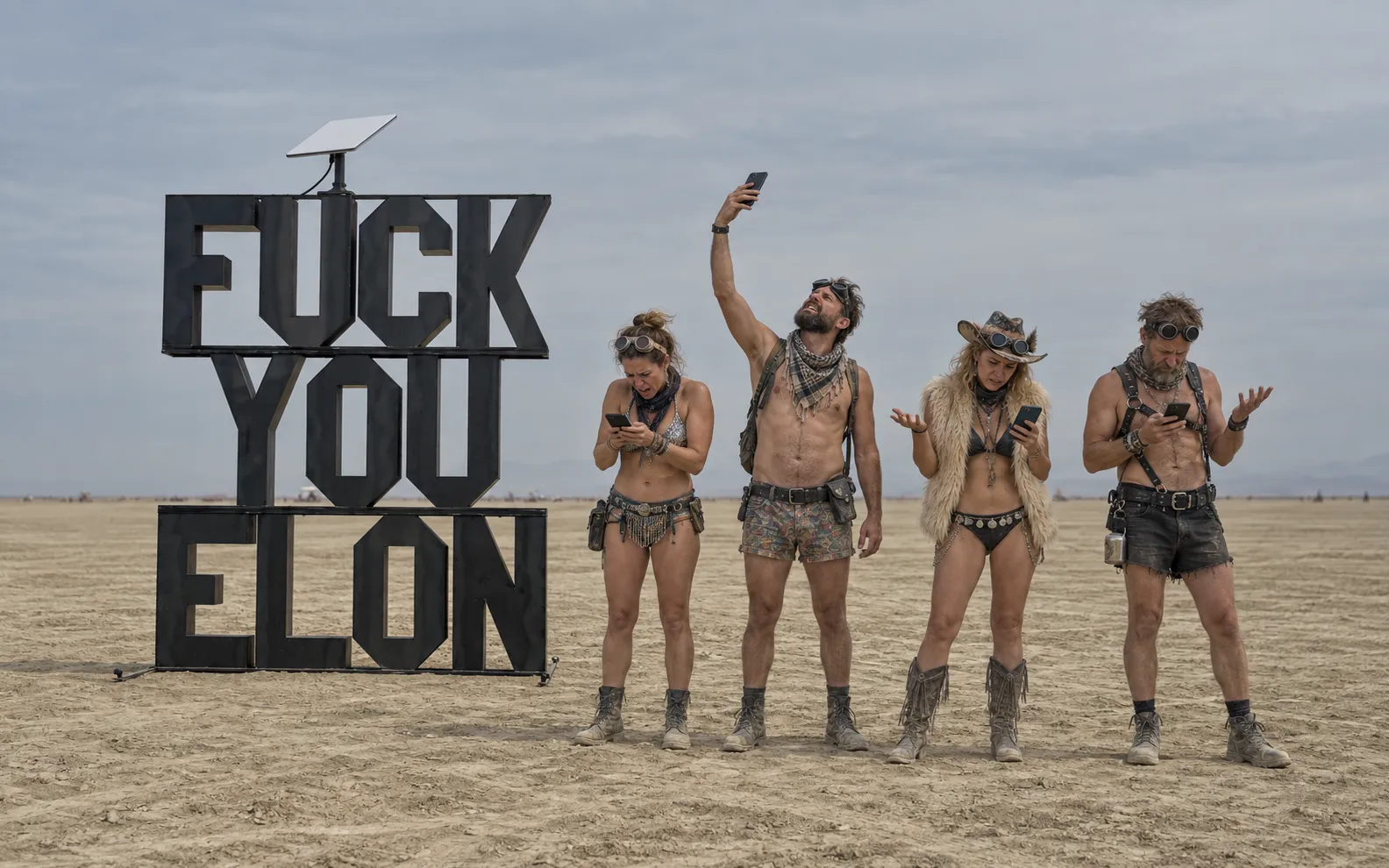
In the Nevada desert, at Burning Man 2025, someone erected a sign declaring “FUCK YOU ELON.” At last, a breakthrough in human expression: a comments section with structural supports. The words were large, the sentiment familiar, and the intellectual journey comfortably short enough to complete without putting down your drink.
Burning Man invites people to imagine other ways of living. This particular contribution imagined telling a billionaire to fuck off. An ambitious civilization might have attempted a water system. We got enlarged punctuation for an argument already available on every phone.
It recalls James P. Hogan’s 1980 short story “Neander-Tale.” Og discovers how to make fire, alarms the tribal establishment, and gets banished. He encounters another outcast associated with that equally suspicious innovation, the wheel. Progress relocates. His former tribe retains its principles until an ice age conducts the peer review. Much later, the surviving message on the rocks reads: “OG, COME HOME. NAME YOUR PRICE.”
The tribe had achieved consensus. Unfortunately, consensus had a disappointing thermal output.
Our modern version has a refinement. We can denounce Og while continuing to enjoy the fire. At Burning Man, Starlink supplied internet access to camps whose inhabitants could therefore remain connected while celebrating their escape from ordinary civilization. The desert had acquired broadband. Enlightenment could now be uploaded before breakfast.
How many Starlink terminals were there? No reliable public total emerged from the available reporting. Claims of hundreds or thousands circulate among participants, but anecdotes are not an inventory. There is firmer evidence of demand: Ookla’s measurements in Pershing County show median Starlink download speeds falling from roughly 248 Mbps on August 21 to 66 Mbps on August 28, during the 2025 event. Those are regional measurements, not a terminal census. Still, the network was plainly doing more than serving as a metaphor. Ookla presentation, page 5
Somewhere between radical self-expression and radical self-reliance, there was substantial demand for radical signal strength.
Naturally, buying internet access does not oblige anyone to approve of its provider’s boss. A subscription is not a medieval oath of loyalty. Nor does the existence of Starlink establish that the sign’s makers used it. The amusing contrast is broader: Musk’s technological ambitions can look embarrassingly useful in the very desert where contempt for him becomes an attraction.
That usefulness deserves more weight than it tends to receive. Under Musk’s leadership, SpaceX has built rockets whose boosters land and fly again, and spacecraft that carry astronauts. NASA entrusted crews to that hardware. These achievements have to survive gravity, heat, vibration and inspection. A slogan merely has to survive agreement. NASA
Engineers, technicians and many others made those machines work. Giving Musk credit does not require imagining him personally soldering every satellite. Organizing talent, risking capital and insisting that an allegedly impractical thing should become routine are contributions too. The orchestra matters. So does getting it assembled, funded and playing something harder than the national anthem of lowered expectations.
This is where the desert setting becomes particularly delicious. A hostile landscape is an invitation to solve problems: energy, shelter, water, transport, communication. Musk’s ambition to extend human settlement to Mars takes that invitation to an extravagant extreme. You can dispute the timetable. The underlying impulse remains more interesting than arranging your disappointment into very large letters. SpaceX’s Mars vision
Imagine directing that appetite for invention toward making arid places more habitable: reliable power, carefully managed water, productive greenhouses. Then imagine carrying some of those capabilities farther. Blooming landscapes on Mars remain a speculative dream; applauding Elon harder will not conjure an atmosphere. But a greenhouse requires someone willing to work through an unreasonable number of problems. A sneer requires excellent facial muscle control.
There is something wonderfully modest about demanding that humanity abandon its grand projects until their most conspicuous advocate develops an agreeable personality. History’s recruitment department would struggle with that rule. We might still be waiting for a sufficiently tactful candidate to introduce the wheel.
To be fair, Burning Man itself depends on people who understand this. Its builders erect structures, distribute power, organize water and make remarkable objects function in punishing conditions. They know that wanting something and building it are different activities. The festival’s best argument for human possibility is the city its participants create. That makes a four-word dismissal feel especially underemployed. Burning Man’s 2025 AfterBurn
Art can challenge power with intelligence, beauty, cruelty or a genuinely surprising idea. This sign offers the emotional complexity of a parking dispute. Calling it transgressive seems generous when the intended audience can applaud without revising a single opinion. The safest possible rebellion is the one for which your entire social circle has already supplied the caption.
Elon Musk can be criticized. He can also be credited. An adult civilization ought to possess enough mental bandwidth for both operations, preferably without waiting for a satellite upgrade. My sympathies lie with the people attempting difficult, useful things, including the troublesome man who keeps assembling companies to attempt them.
Og’s village eventually discovered that moral certainty could not keep it warm. Black Rock City has a happier option: enjoy the fire, argue with the inventor, and perhaps contribute another invention.
Meanwhile, future archaeologists may find two inscriptions in the Nevada dust. The first will announce, with magnificent confidence, “FUCK YOU ELON.”
The second, scratched underneath in smaller letters, will ask for the Wi-Fi password.
No comments yet