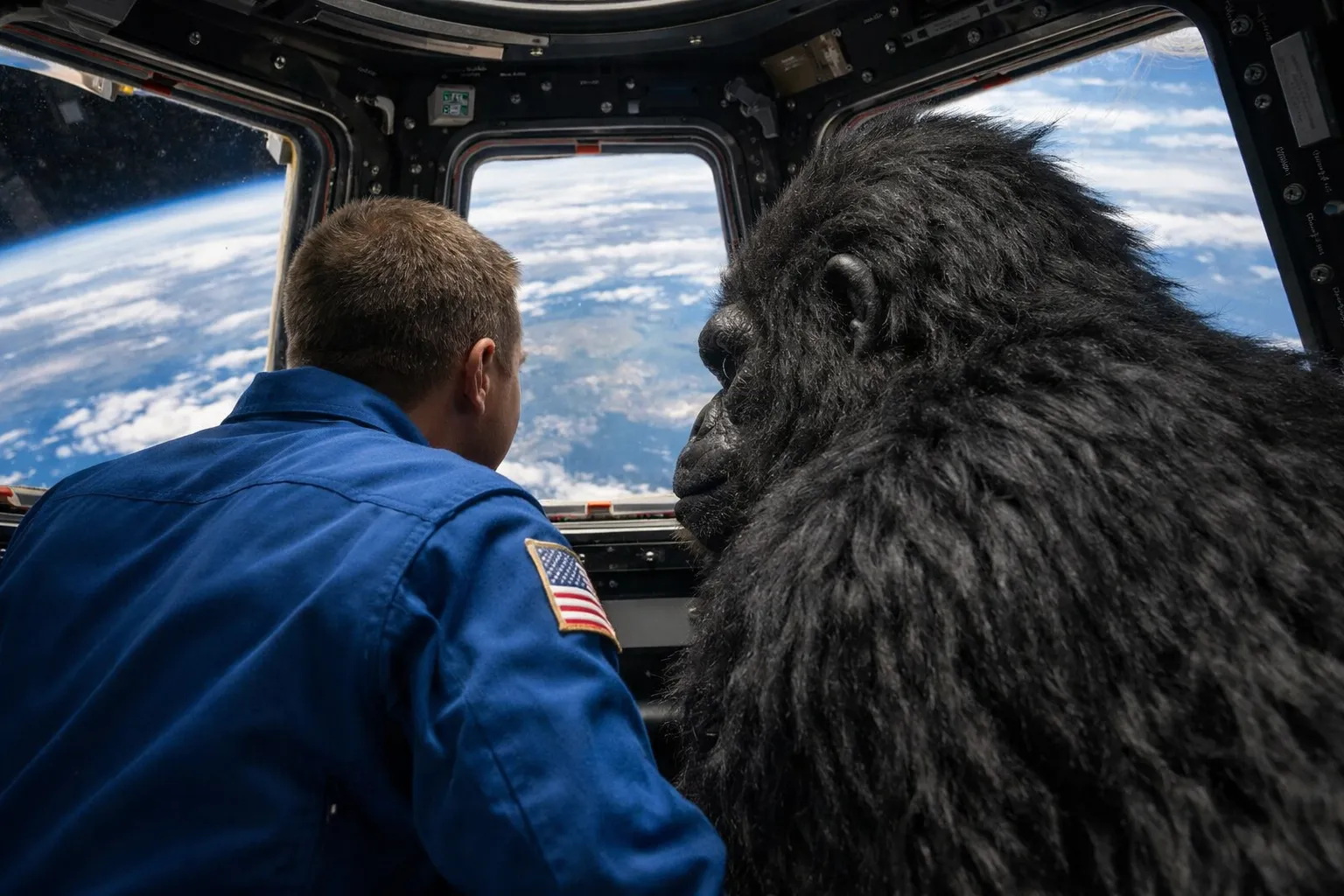
There is a particular kind of joke that works only in space. On Earth, a man in a gorilla suit is a prank. On the International Space Station, a man in a gorilla suit becomes a minor ontological crisis. NASA’s own retrospective on ISS birthdays notes that Mark Kelly arranged to send a life-size gorilla costume to Scott Kelly for his birthday during the one-year mission, and that Scott then used it for “mild-mannered shenanigans,” including chasing Tim Peake through the Destiny module. That really happened. It is not folklore, not internet drift, not one of those stories that improves with each retelling. The official version is already absurd enough.
Then there is Ad Astra. James Gray’s film is, for long stretches, a solemn and beautifully self-serious meditation on fathers, distance, male repression, imperial loneliness, and the possibility that humanity may haul all of its unresolved damage with it into the solar system. And then, without warning, Brad Pitt boards a distressed spacecraft and finds himself in a zero-gravity knife fight with deranged research baboons. The scene lands with such force precisely because it violates the tonal treaty the film had previously signed with the audience. Gray described the film elsewhere as “plausible science fiction,” shaped by reference to For All Mankind and by conversations with space experts. The baboon sequence itself was technically difficult enough that he discussed it largely as a staging problem, while one of the film’s editors gave the deeper reason: the baboons were meant as a sign of isolation, animal testing, and the “primal component” of human nature.
So where did the filmmakers get the idea? Publicly, at least from the interviews I could find, there is no neat confession along the lines of: yes, we saw Scott Kelly’s gorilla prank and decided to make the evil version. What does exist is more interesting. The film’s own creative explanation points inward, not outward. The baboons are not there as a random pulp flourish. They are there because Ad Astra wants to insist that space does not civilize us. It merely removes the furniture. Strip away breathable atmosphere, weather, crowds, institutions, grass, dogs, wives, pubs, and the comforting stupidity of ordinary life, and what remains is not the enlightened astronaut of recruitment posters. What remains may be a frightened mammal in a machine. The editor’s comments are striking on this point: the baboons foreshadow what isolation does to the human mind and symbolize the instincts beneath our polished surface.
And yet the Scott Kelly gorilla episode feels uncannily adjacent, as though reality had already sketched the comic version of the same insight. Because that prank did not merely put an ape-shaped silhouette into orbit. It punctured one of modernity’s favorite myths: that the astronaut is a priest of reason, purified by training, checklists, and hardware. Spaceflight certainly demands extraordinary discipline, but astronauts remain men trapped in a tube for months, which means they also remain susceptible to boredom, mischief, cabin fever, and the irrepressible urge to make a colleague scream for no noble reason whatsoever. The gorilla suit was funny precisely because it revealed the human animal inside the stainless-steel mythology of the space age. NASA’s summary, charmingly deadpan, almost undersells the point. A gorilla chasing Tim Peake through a weightless corridor is not a deviation from human behavior in space. It is human behavior in space.
This is why the connection between Scott Kelly’s prank and Ad Astra’s baboons is worth making, even if it is only a cultural connection and not a documented line of influence. Both images operate by the same sabotage. They insert the simian into the futuristic. They contaminate the clean geometry of spacecraft interiors with the older, louder truth of primate life. In one case the effect is comic. In the other it is horror. But the mechanism is identical. The spaceship, that pinnacle of technical aspiration, suddenly becomes a zoo enclosure with better instrumentation. The astronaut, that icon of self-command, becomes either the prankster in the suit or the man trying not to be torn open by something more primitive than he is. One scene says: the monkey is still in us. The other says: it may even outrank us.
There is also something almost too perfect in the national contrast. Kelly’s ISS gorilla is American space culture at its healthiest: competence with enough slack left for humor. Ad Astra’s Norwegian research vessel Cetus, by contrast, turns the same animal intrusion into a European laboratory nightmare, all grim protocols and failed containment. One scenario ends as a viral anecdote. The other ends with a face being chewed off in microgravity. It is the difference between a practical joke and a parable. But both draw power from the same intuitive recognition that our machines may travel far faster than our species matures.
That, I suspect, is the real source of the baboon idea in Ad Astra. Not one specific prank video, not one neat anecdote passed around a writer’s room, but a larger modern unease. We are very good at building shells. Capsules, stations, rovers, habitats, helmets, brands, and voices trained to remain calm under biometric supervision. We are much less good at abolishing the old freight inside the shell. Gray’s film says as much in solemn tones. Scott Kelly’s gorilla said it better, and with more economy. Send enough titanium, sensors, and freeze-dried food into orbit, and eventually someone will still put on a monkey suit. Or meet one.
Perhaps that is why the baboon ambush in Ad Astra feels so unforgettable. It is not merely “unexpected.” It is honest in a way the rest of prestige science fiction often is not. Space will not turn us into pure intellects. It will export our hierarchies, our neuroses, our animal experiments, our jokes, and our appetite for panic. We will carry slapstick and nightmare with us together. First the gorilla drifts out of a storage bag and chases a British astronaut down the module. Then, in the movies, the joke curdles and comes back with teeth.
That is not a failure of imagination. It may be the most realistic thing either story has to say.
No comments yet