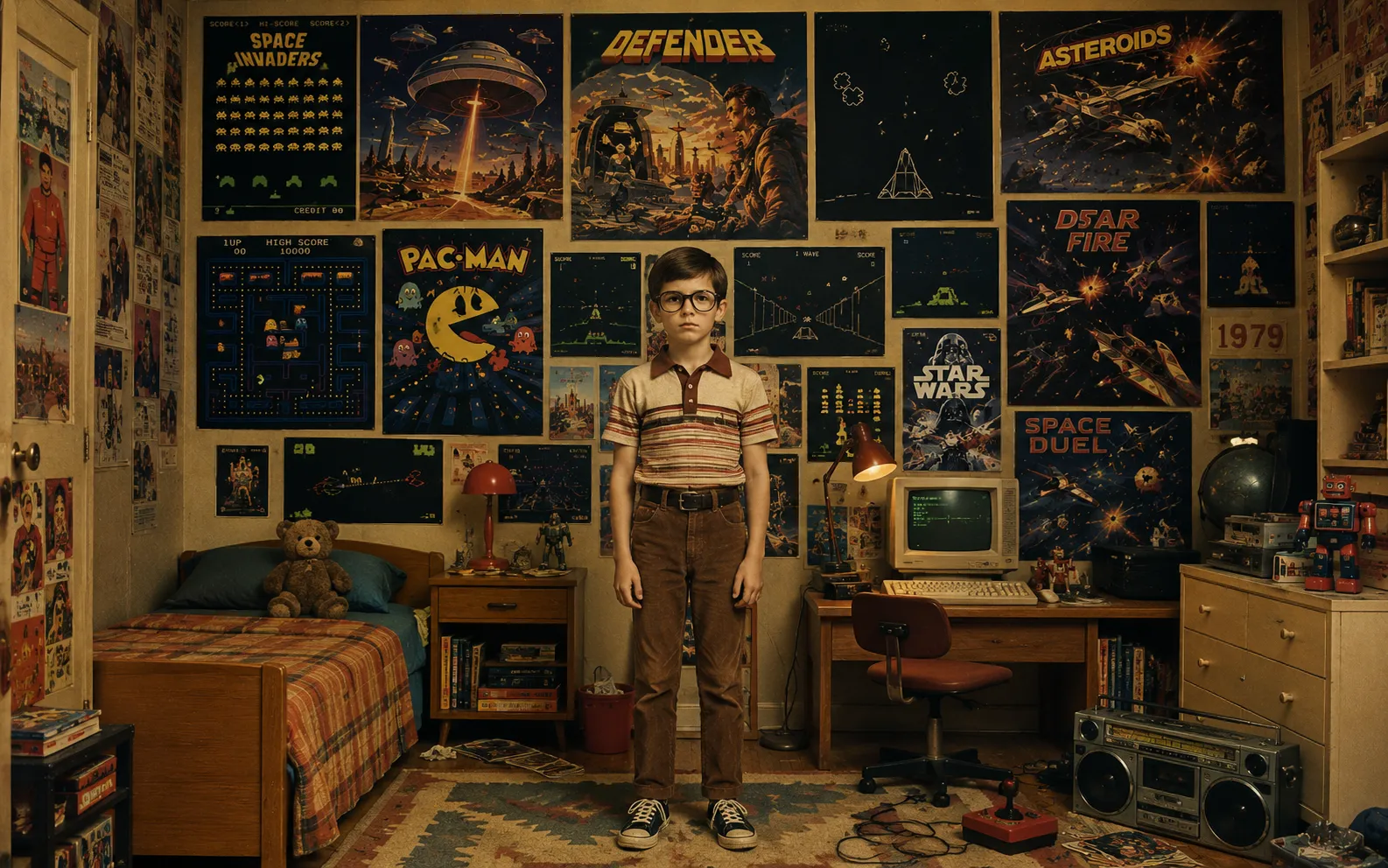
There was a time when the most important graphics chip in a video game was not inside the machine. It was inside the player.
A boy in 1982 might pick up a cardboard box in a computer shop and see, on its cover, a chrome spaceship diving through a storm of laser fire above a burning planet. There might be an astronaut with heroic shoulders, an alien fortress glowing in the distance, perhaps a woman whose clothing suggested that the future had solved interstellar travel but not practicality. The title would be rendered in metallic letters, as if forged in a factory that produced only destiny.
Then the box would be opened, the cassette loaded, the cartridge inserted, and the television would reveal the truth: twelve pixels, two colors, a noise like a distressed kitchen appliance, and a small square moving with the solemn determination of a tax form.
This was not necessarily a disappointment. At least not in the way one might expect.
The strange glory of late-seventies and early-eighties computer-game box art was that almost nobody believed it was an accurate representation of the game. It was not a screenshot. It was not a product photograph. It was not even a particularly honest visual summary. It was a promise of atmosphere.
The box did not say: this is what the game looks like.
It said: this is what you are supposed to imagine while playing it.
That distinction matters.
Early home computers and consoles were machines of suggestion. The Atari 2600, the Commodore 64, the ZX Spectrum, and the Apple II did not so much depict worlds as negotiate them with the viewer. A spaceship could be a triangle. A dragon could be a flickering obstruction. A dungeon could be a set of lines, provided the player agreed not to ask too many questions.
The player was not a passive consumer of graphics. He was a collaborator. The machine contributed movement, rules, sound, and failure. The player contributed weather, scale, danger, personality, and most of the furniture.
Box art supplied the missing contract. It trained the imagination before the game began. It gave the player a visual vocabulary with which to interpret the crude signals on the screen. Those few pixels were not merely pixels; they were the reduced notation of a much larger fantasy.
In this sense, the painting on the cardboard was not separate from the game. It was part of the interface.
Modern eyes tend to treat this as a comic mismatch. We place the box beside the screenshot and laugh at the distance between them. There is the painted barbarian, sword raised beneath a blood-red moon; and there, beside him, the game itself, in which a beige rectangle nudges another beige rectangle across a field of black.
But the comparison is unfair. The screenshot shows what the machine could render. The box shows what the experience was trying to become.
This is not so different from reading. A novel does not provide the image of a castle, the exact face of the countess, or the smell of the ruined garden. It gives instructions. The reader constructs the rest. Early games, by accident or necessity, worked in a similar way. Their poverty of representation made them strangely literary.
The player had to complete them.
This may help explain why so many technically primitive games remain emotionally vivid in memory. The experience remembered is not identical with the experience displayed. Memory quietly upgrades the graphics. It imports the box art, the manual, the bedroom carpet, the glowing television, the loading screen, the smell of warmed plastic, and the private mythology of being ten years old and temporarily in command of a universe.
The game that existed on the screen was small.
The game that existed in the head was enormous.
One might say that the old box artists were selling a lie. But that is too simple. They were selling a role for the player. The lie became true only when someone agreed to participate in it.
This is where the old cardboard boxes begin to look oddly contemporary.
Much of modern technology still arrives wrapped in a picture of what it hopes to become. Artificial intelligence is the obvious example. The demo video shows a calm, omniscient assistant arranging travel, writing code, summarizing meetings, remembering context, negotiating schedules, comforting the anxious, and generally behaving like Jeeves with a server bill.
Then one uses the product and discovers something more complicated: brilliance interrupted by confusion, fluency interrupted by hallucination, competence that appears suddenly and disappears just as suddenly, like a butler who can translate Sanskrit but cannot be trusted with the shopping list.
The promotional image is not entirely false. It is also not entirely present. It is box art.
It says: this is how you should imagine the technology when it works.
There is, however, an important difference. In 1982, the player understood the gap. Nobody expected the muscular astronaut to appear on the screen in full painted detail. The exaggeration was part of the bargain. The box invited the player to bridge the distance.
Today, the gap is more ambiguous. Technology companies often present future capability in the grammar of present reality. The promise does not sit on cardboard, safely separated from the machine. It appears in polished videos, keynote demonstrations, investor decks, and carefully edited workflows. The viewer is not always sure whether he is seeing a product, a prototype, a roadmap, or a mood board.
The old game box said: bring imagination.
The modern AI demo sometimes says: no imagination required.
That is a more dangerous promise.
Still, there is something valuable in the older arrangement. It acknowledged that technology alone does not create wonder. The machine needs a story large enough for the user to enter. Without that story, even impressive engineering can feel sterile. With it, even a handful of pixels can become a fleet, a kingdom, a labyrinth, a war.
This is why those ridiculous covers deserve more respect than nostalgia usually grants them. They were not merely compensating for weak hardware. They were revealing an uncomfortable truth about all technology: people do not fall in love with specifications. They fall in love with the imaginary life a device permits them to rehearse.
A smartphone is not just a radio computer with a glass surface. It is a promise of competence, connection, memory, escape, status, and control. A car advertisement is rarely about transportation. A university brochure is rarely about lectures. A political campaign poster is rarely about policy detail. These things sell projected selves.
The early game boxes were simply more honest in their dishonesty. Their exaggeration was visible, theatrical, almost innocent. They knew they were mythmaking. They trusted the audience to know it too.
Perhaps that is what makes them so appealing now. Not that they were accurate, but that they preserved the border between reality and fantasy. The box made a claim the machine could not fulfill by itself, and the player accepted the assignment.
Modern products often try to abolish that border. They want the fantasy to be treated as delivery. They want the box art to be accepted as the screenshot.
But the old games suggest a better model. A useful technology does not need to eliminate imagination. It may need to invite it more honestly.
The greatest achievement of those early games was not that they overcame technical limits. They did not. The limits were everywhere: in the blocky graphics, the thin sounds, the flicker, the waiting, the crude controls, the endless compromises.
Their achievement was that they turned limitation into participation.
The box showed the epic. The screen showed the notation. The player supplied the world.
For a moment, that was enough. More than enough. A child could sit before a television, guiding a trembling cluster of pixels through the dark, and feel not cheated but recruited.
The game was not on the screen alone.
The game was on the box, in the manual, in the room, in the machine, and finally in the mind of the player, where all primitive technologies must finish their rendering.


No comments yet