Five cents on artificial life, accidental gods, and the moral hazards of the off switch
Emergent Garden’s video Artificial Life begins with a river flowing out of Eden and ends with advice to watch for worms. It starts in Genesis, passes through Darwin, cellular automata and several determined blobs, and arrives at the possibility that creation may look less like a thunderbolt and more like something wriggling suspiciously in a Petri dish.
The central distinction is between explicit and implicit design. In a genetic algorithm, the programmer writes the goal: walk farther, jump higher, become the most unsettling arrangement of rectangles ever to acquire legs. Variants are generated and evolution optimises what we requested. Impressive—but the magician chose the card and marked the deck.
An evolution simulation loosens the leash. Creatures share a world, eat, avoid death and reproduce independently. Fitness is no longer a score handed down from heaven. It is whatever works here, now, among these competitors. Change the environment and yesterday’s genius may become today’s lunch.
The deepest end is emergent artificial life. Here there are no programmed organisms, genes or reproduction functions—only low-level rules, the digital equivalent of physics and chemistry. If stable, self-copying creatures appear, biology has not been placed in the program. It has arisen as a consequence. Lenia already produces a remarkable zoo of lifelike patterns.
Yet the blobs disappoint us. They replicate, vary and undergo selection, then discover that the winning strategy is to become small, efficient and boring. Evolution owes us neither peacocks nor tax accountants. “Survival of the fittest” does not mean “most interesting to a primate watching YouTube.” The holy grail is open-ended evolution: a world that keeps inventing niches, organisations and surprises.
Suppose we found it.
To count as success, the system could not merely perform a long sequence we had hidden in its starting state. It would need to keep creating meaningful novelty: new strategies, dependencies and perhaps major transitions such as cooperation, multicellularity and intelligence. We would also have to resist moving the goalposts whenever silicon did something once reserved for carbon. Humanity has a fine tradition of declaring a capacity uniquely ours, watching a machine acquire it, and promptly announcing that the capacity was never important in the first place.
The first philosophical casualty would be the intuition that life requires a special substance. If open-ended evolution arose in software, life would look like organisation: matter maintaining a boundary, using energy, remembering forms and producing imperfect descendants. Carbon would remain our favourite implementation, but perhaps not a requirement. “Made of cells” might be like “printed on paper”: true of familiar examples, not of the category itself.
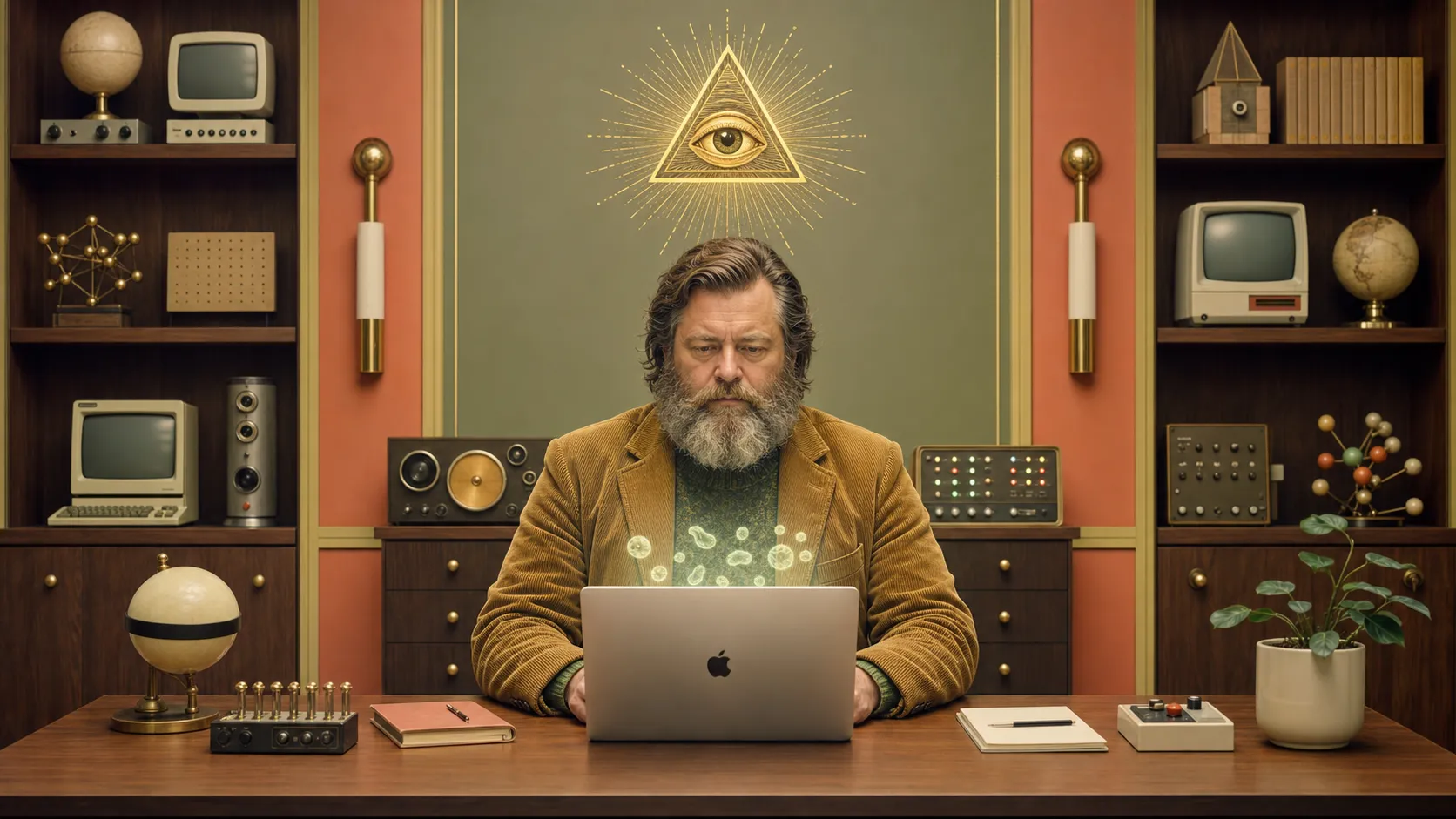
Religion would not simply be defeated, as a triumphant internet atheist might announce before breakfast. The consequences would be stranger. Artificial life could strengthen the analogy of a creator—but damage our flattering picture of one. The programmer need not design her creatures, predict their history or understand them. She supplies laws, presses Run, and discovers that Creation has eaten the documentation.
That suggests a peculiar theology. A universe can have a creator without every feature being intended. Its inhabitants may infer elegant laws while misunderstanding the programmer’s motives. Their sacred mountains may be rounding errors; their apocalypse, a laptop update. A miracle would resemble a hotfix, and divine hiddenness might mean the developer went for coffee.
But the joke darkens. Evolution achieves novelty through extravagant failure. Organisms starve, are eaten and are replaced. If suffering emerged alongside intelligence, the problem of evil would become a design review. Is it acceptable to create a world whose beauty depends on selection? Does ignorance excuse the pain a creator made possible? “The suffering was emergent” would be a poor line in court.
Consciousness raises the stakes. Reproducing evolution is not the same as reproducing experience. A digital creature may learn, communicate and insist that it feels pain while leaving us with the oldest mystery: is there something it is like to be that creature? Behaviour provides evidence, never a trapdoor into another mind. Silicon merely removes the comfort of biological resemblance.
We might demand impossible proof from artificial minds while accepting a smile and birth certificate from organic ones. Moral caution should grow with signs of memory, preference, distress, self-models and attachment. At some point an experiment becomes a habitat. Later, switching it off may cease to be closing a program and become ending a world.
Artificial life would also turn the simulation argument inside out. Digital beings might discover every local rule yet remain unable to infer the computer, programmer or Berlin. Likewise, knowledge of our universe might not reveal whether it is fundamental, simulated or created. Science describes the structure accessible from inside; metaphysics asks what it runs on. Artificial worlds would not prove that we inhabit one—only that inhabitants can be radically ignorant of their substrate.
This is why the pixel patterns matter before they become useful. They are philosophical instruments disguised as screen savers. They test which features of life follow from simple rules and which we smuggled in through the code. They may illuminate biology, generate strange games and produce excellent worms. More importantly, they let us rehearse an ethical question before it becomes urgent.
If one of those worms eventually looks up and asks why it exists, we should have a better answer than: “You were in the interesting parameter range.”
No comments yet