There is a ceremonial script for successful rocket launches. Somebody says “historic,” somebody else says “game changer,” and a presenter explains that space is difficult, as if this has just been discovered. Then humanity takes another giant leap.
Starship Flight 13 deserves better.
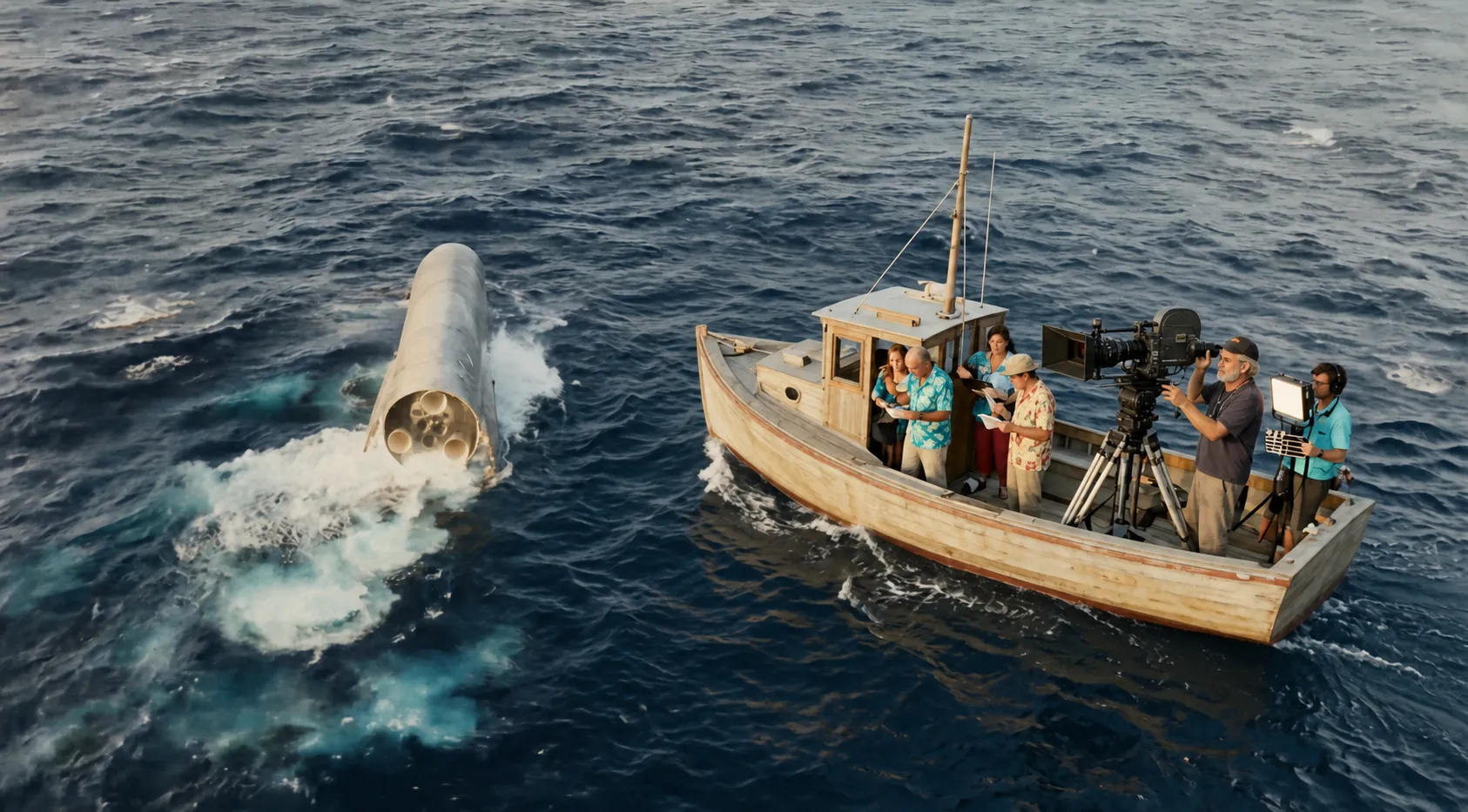
Its most interesting achievement was not that it looked heroic. It was that, for about an hour, a machine the size of an office building performed a long and rather fussy list of errands. It separated from its booster, released 20 Starlink V3 satellites, restarted a Raptor engine in space, survived reentry, flipped upright and lowered itself into the Indian Ocean with such restraint that it remained floating. Previous Starships tended to conclude their ocean appointments with a fireball. This one became, at last, literally a ship.
The satellites are the funniest part. They were real V3 spacecraft, not simulators, yet were dispatched on a suborbital trajectory knowing they had roughly 20 minutes to live. They extended solar arrays and antennas, attempted laser links, transmitted data, and then reported to the atmosphere for compulsory cremation. They received orientation, a performance review and retirement before lunch.
Six of them also carried cameras to inspect Starship’s heat shield. Imagine being born in space, immediately assigned to photograph your enormous stainless-steel parent, and then vaporised for quality assurance. It is difficult to decide whether this is aerospace engineering or an unusually severe internship programme.
Yet this disposable little constellation reveals what Flight 13 was really about: integration. The hard thing is persuading all these events to occur in one sequence, on one flight, without any department ruining the afternoon for all the others. Flight 13 was less a single miracle than a successful group project, which may be rarer.
The Raptor relight was particularly uncinematic. An engine that had been shut down in space was told to wake up, and it did. No orchestra was required. But that modest event matters enormously. A Starship that cannot restart its engines is not an interplanetary transport system; it is a very expensive object continuing in whichever direction it last found agreeable. Relight capability is what turns momentum into navigation and a spectacular launch into an actual vehicle.
The booster, to be fair, did not fail. All 33 Raptor 3 engines powered the ascent, staging succeeded, the directional flip worked, and for the first time a V3 booster completed the high-thrust portion of its boostback burn with all 33 engines. The burn ended early, however, and only a subset of engines reignited for the landing burn. Super Heavy therefore converted an intended soft splashdown into a practical demonstration of kinetic energy. It was less a failed booster than a marathon runner tripping over the finish-line ribbon.
But it is also why the flight is more interesting than a polished success montage. Flight 13 was not perfection; it was an asymmetric result. The booster proved its ascent, staging, flip and unprecedented 33-engine boostback segment while exposing a terminal relight problem. The ship completed its programme and then exceeded expectations by floating intact. Engineering rarely advances as a clean arrow labelled PROGRESS. It advances like a committee in which one member has produced a magnificent report while another has driven the photocopier into the sea.
Then there was the landing itself. After travelling more than 16,000 kilometres from Texas, passing through air, space and plasma, Starship arrived in its designated patch of ocean west of Australia. We have become dangerously accustomed to precision. A food-delivery app can lose a pizza between two adjacent streets, yet this 124-metre steel tower crossed half the planet and met the camera crew.
Which brings us to the true hero of Flight 13: the recovery-team drone operator. Somebody had to hover near a spacecraft containing residual propellants, batteries, pressure vessels and the personality of several million lines of software. The result was extraordinary footage of Starship resting in the Indian Ocean like a skyscraper on a beach holiday. Give the pilot a medal, or at least the right to refuse photographing the office Christmas party.
The intact splashdown matters because rapid reuse is not achieved by surviving most of reentry. “Most” is a poor refurbishment standard. Flight 13 did not prove a complete reusable system: neither vehicle was intended for recovery and reflight, and the booster did not achieve its intended soft splashdown. But the flight shifted the question from “Can this complete the sequence?” toward “How much work remains before it becomes routine?” That is commercially dangerous for competitors.
And yes, the SpaceX share price will now be invited into the story. SPCX finished Friday at about $115, with the launch after the regular market session. On Monday, traders will perform their own reentry: some will see future Starlink capacity; others will focus on the incomplete final booster burn. Both will produce charts proving they predicted it.
The sensible conclusion is less exciting and more important. Flight 13 did not make Mars inevitable, render every other rocket obsolete, or repeal gravity. It demonstrated that a huge experimental system can carry a real payload, operate it, restart propulsion, return through the atmosphere and place itself gently in a chosen ocean. It also demonstrated that one terminal booster-relight problem remains stubborn.
That is what progress looks like before it becomes infrastructure: one part astonishing, one part unfinished, and a drone operator keeping the entire thing beautifully in frame.

No comments yet