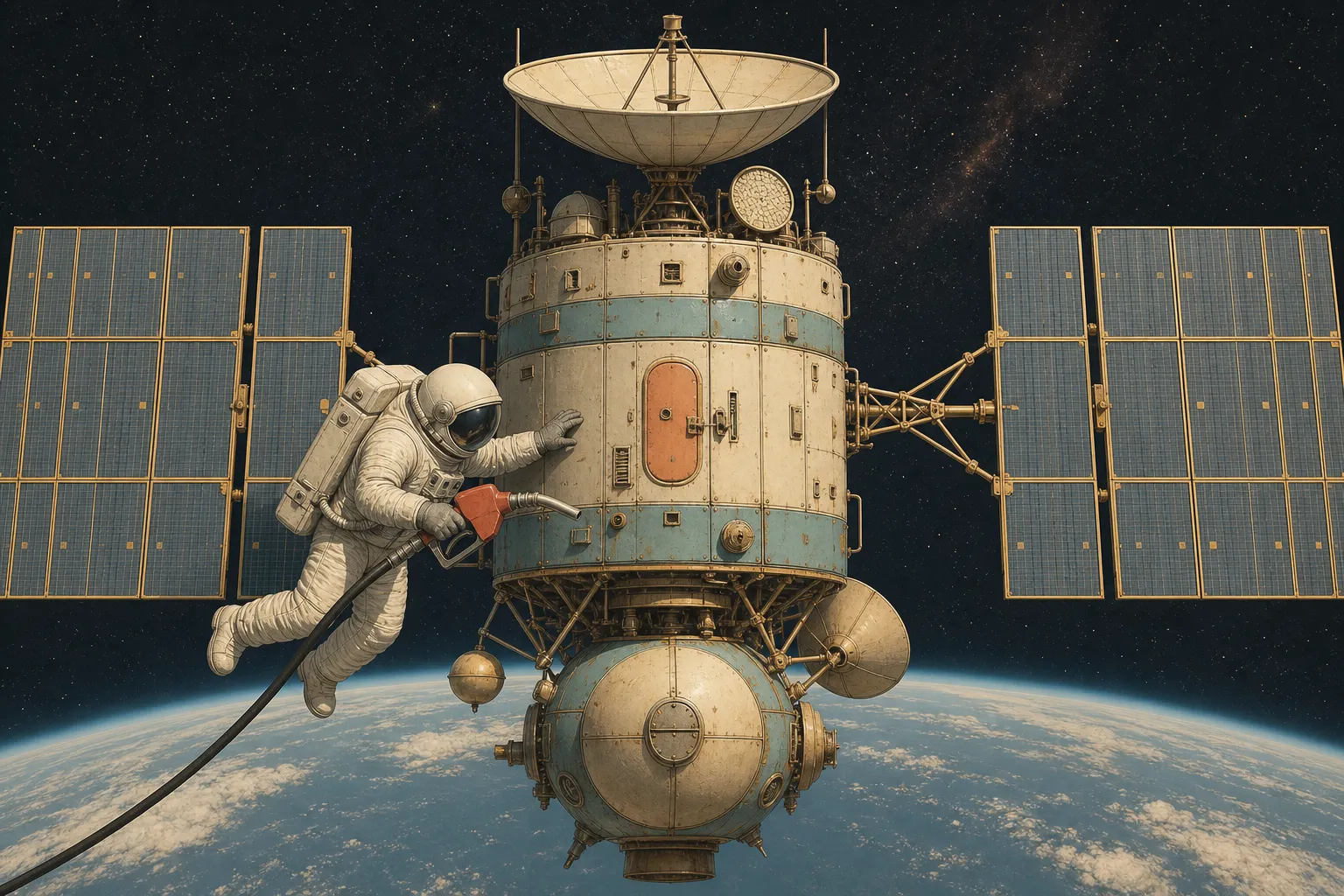
On July 21, 2026, a SpaceX Falcon 9 launched an unusually ambitious payload from Cape Canaveral: Northrop Grumman’s Mission Robotic Vehicle, or MRV, accompanied by three Mission Extension Pods. SpaceX provided the launch, while the spacecraft will be owned and operated by Northrop Grumman’s SpaceLogistics subsidiary. The MRV carries a robotic system developed through DARPA’s Robotic Servicing of Geosynchronous Satellites program. After an approximately year-long, electric-propulsion journey to geosynchronous orbit, it is intended to use two dexterous robotic arms to attach the pods to aging satellites. Each pod functions as an auxiliary propulsion system—a “jetpack” that can take over essential orbital maneuvers when the host satellite’s fuel is nearly exhausted. DARPA describes the mission as the first privately owned operational robotic servicing mission in geosynchronous orbit.
The mission addresses a fundamental inefficiency in conventional spacecraft design. Most satellites are launched as sealed, disposable machines. They cannot be refueled, repaired or upgraded, even though they may cost hundreds of millions of dollars. Communications satellites in geostationary orbit must regularly perform station-keeping maneuvers, unload momentum from their reaction wheels and maintain precise antenna pointing. Eventually their propellant runs out, although their transponders, computers, solar arrays and communications payloads may remain functional. As NASA explains, many satellites reach the end of their nominal lives because of depleted fuel or technological obsolescence rather than the complete failure of their hardware.
Extending such a satellite’s life can therefore preserve a productive asset and prevent interruptions to services such as television distribution, broadband connectivity, weather monitoring and government communications. It also gives operators more flexibility. Instead of replacing a satellite according to a rigid fuel deadline, a company can keep it operating while demand, financing and replacement technology evolve. Northrop Grumman has already demonstrated the basic business model: its earlier Mission Extension Vehicles docked with Intelsat satellites in 2020 and 2021 and supplied propulsion and attitude control. One of those vehicles completed its first five-year assignment in 2025 before moving to another customer. Northrop Grumman’s mission history shows that satellite servicing is no longer merely a laboratory concept.
The new architecture could be more economical. A Mission Extension Vehicle must remain attached to its customer, whereas the MRV installs a smaller pod and then departs for another assignment. According to the current Mission Extension Pod specifications, one pod can provide as much as eight additional years of maneuvering capability to a typical 2,000-kilogram satellite. Separating the reusable servicing robot from the equipment left with each customer resembles the difference between owning a repair workshop and permanently assigning an entire repair truck to every machine.
Nevertheless, life extension is not automatically economical. Servicing makes sense only when the satellite’s remaining revenue or strategic value exceeds the cost and risk of the intervention. An old spacecraft may have limited electrical power, degraded batteries or obsolete communications capacity. Additional propulsion cannot repair every electronic failure, and keeping an inefficient satellite alive may delay deployment of a substantially more capable replacement. Operators must therefore evaluate each candidate individually rather than treating extra fuel as a universal cure.
The environmental argument is similarly conditional. Extending a healthy spacecraft can reduce the immediate need to manufacture and launch a replacement, while a servicing vehicle could eventually help move satellites into disposal orbits. But servicing also places additional hardware in space and keeps existing objects in valuable orbital regions for longer. ESA’s June 2026 statistics list about 46,000 regularly tracked objects in Earth orbit and estimate approximately 1.2 million debris objects between one and ten centimetres—large enough to cause catastrophic damage in a collision. ESA consequently describes orbital space as a finite resource. Satellite servicing is sustainable only if the combined spacecraft remains controllable and retains a credible end-of-life disposal plan. Otherwise, life extension could merely postpone the creation of another derelict object.
The immediate engineering challenge is that most current satellites were never designed to be serviced. They may lack standardized grappling fixtures, refueling ports or easily replaceable components. The MRV must approach a valuable spacecraft, determine its exact motion and condition, and manipulate it without striking antennas, solar arrays or insulation. Its technical configuration includes two three-metre arms with seven degrees of freedom each and more than twenty situational-awareness cameras. Yet even extensive ground testing cannot perfectly reproduce unusual lighting, radiation, thermal cycling or the dynamics of two large spacecraft making contact. After installation, the pod and host must also behave as a stable combined system with altered mass and inertia.
Commercialization presents another obstacle. A 2025 U.S. Government Accountability Office assessment identified a persistent chicken-and-egg problem: servicing companies hesitate to invest without a substantial customer base, while satellite operators hesitate to design serviceable spacecraft before reliable services exist. Demonstration opportunities remain scarce, and regulations and technical standards are still developing. Common mechanical interfaces, refueling connections, command protocols and safety procedures could make future servicing far less difficult, but agreeing on them across manufacturers and countries will take time.
Finally, close-proximity operations have legal and security implications. Under Article VIII of the Outer Space Treaty, a state retains jurisdiction and control over its registered spacecraft, while ownership continues in orbit. Servicing therefore requires explicit authorization and careful coordination. The same robot that can inspect or relocate a cooperative satellite could potentially interfere with an uncooperative one. Transparency, advance notification, cybersecurity, insurance and clear responsibility for accidental damage will be as important as robotic dexterity.
The MRV mission is thus more than a rescue operation for fuel-starved satellites. It is an experiment in replacing the throwaway spacecraft model with maintainable orbital infrastructure. Its real success will not be measured by a single docking, but by whether servicing becomes safe, repeatable, commercially viable and inseparable from responsible disposal.

No comments yet