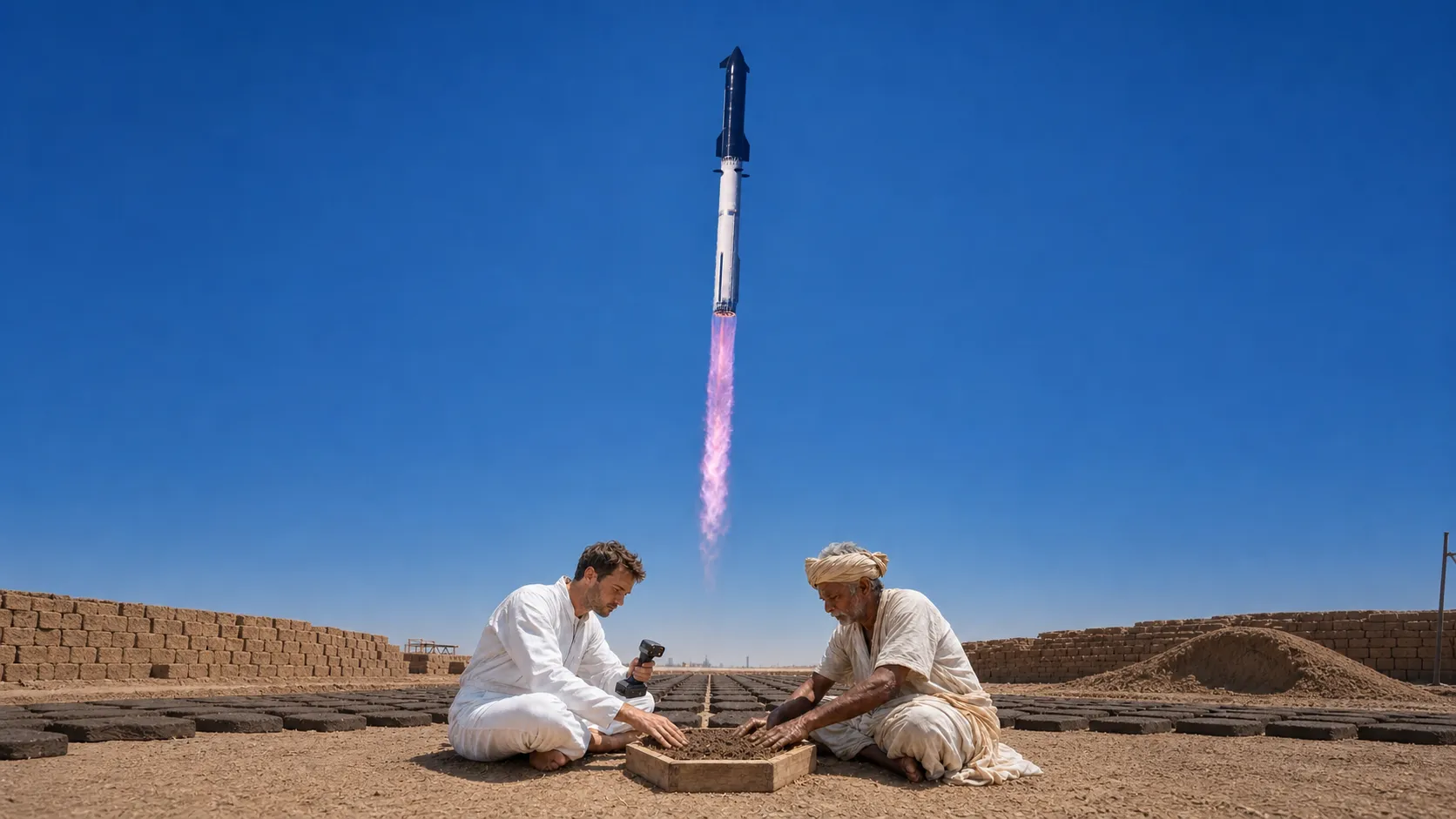
Yes, Starship’s heat-shield problem was foreseeable. What was not predictable was how severe it would remain after thirteen flights—or how quickly SpaceX could reduce it.
Flight 13 on July 24 was not an operational mission that unexpectedly returned a damaged vehicle. It was an instrumented development flight deliberately exposing Starship V3 to higher aerodynamic loads. The ship deployed twenty Starlink V3 satellites, relit a Raptor in space, survived re-entry, executed its landing manoeuvre and splashed down so gently that it remained afloat. Super Heavy, by contrast, hit the sea too fast after several engines failed to relight. Conflating that booster failure with the ship’s heat-shield condition obscures what actually happened.
The post-flight images nevertheless matter. Only a few of Starship’s roughly 18,000 ceramic tiles appear to have been lost, but cracked edges and white streaks originating at tile gaps suggest that hot gas penetrated parts of the shield.
That is acceptable for an experimental vehicle reaching the ocean. It is not yet evidence that the same ship could be refuelled and relaunched. The sceptics are therefore asking the right question, even if “dead end” is a premature answer.
The Space Shuttle comparison is useful—but incomplete. NASA inspected approximately 24,000 silica tiles and 8,000 thermal blankets after each landing. A typical Shuttle processing template allocated 93 days to the orbiter and 126 days from hangar entry to the next launch. Its original tiles were individually shaped and hand-installed; NASA records 670,000 labour hours for the initial installation. NASA’s operations history, NASA’s tile history
Starship has three important advantages. Its tiles contain many repeated hexagonal units suitable for machine vision and robotic handling. Its stainless-steel structure tolerates far more heat than the Shuttle’s aluminium airframe. And payload dilutes maintenance: SpaceX specifies 100 metric tons to orbit for reusable Starship V3, versus the Shuttle’s roughly 29.5-ton maximum and around 20 tons for a representative expendable launcher. SpaceX prospectus
We can express the economics directly. Let be the number of tiles replaced after a flight, the vehicle’s lifetime in flights, its construction cost, all non-tile marginal costs, the installed cost per replacement tile, the opportunity cost of one day on the ground, and the value exposed to a residual probability of loss . Then:
Automated turnaround can be modelled as
where , scanner heads inspect at tiles per hour, repair robots replace tiles per hour, and covers fuelling-system checks, engines, flaps and other fixed work.
Suppose eight scanners each process two tiles per minute. Full-shield inspection takes
Six robots replacing two tiles per hour need 25 hours for 300 tiles. With 24 hours of other work, pessimistically treating the steps as sequential gives
or 2.8 days. Even 1,000 replacements produce a turnaround of only about 5.3 days. That misses SpaceX’s extraordinary stated ambition of sub-one-hour reflight, but it is nothing like Shuttle processing—and it may still be economically transformative.
For an expendable alternative carrying tons at cost , while Starship delivers a fraction of its payload capacity , reuse wins when
Ignoring the nonlinear reliability term temporarily, the maximum affordable tile count is
Consider a deliberately hypothetical sensitivity case: tons, tons, million, million, , million, per tile and per day. At only 20 percent payload utilisation, break-even permits approximately 5,300 tile replacements per flight. At full utilisation, the calculated allowance exceeds the entire shield. The numerical result is not a Starship cost forecast; it demonstrates that tile material and robotic labour are unlikely to be the economic showstopper.
The break-even lifetime is similarly simple:
With 300 replacements and the illustrative costs above, a fully loaded Starship beats the expendable alternative on its first mission. At 20 percent utilisation, it crosses the cumulative threshold on approximately its third flight.
But money is not the strictest constraint. One missing tile in a critical location can matter more than a thousand chipped tiles elsewhere. Inspection must detect subsurface cracks, damaged attachment pins and compromised gap seals with near-perfect reliability. Consequently, the real limiting term may be , not .
Flight 13 therefore proved neither airline-like reuse nor a Shuttle-style dead end. It showed that Starship can survive a deliberately severe flight with a mostly intact shield—and exposed the refurbishment problem clearly enough to measure it. That is not operational success. For a test flight, however, it is almost the definition of progress.


No comments yet