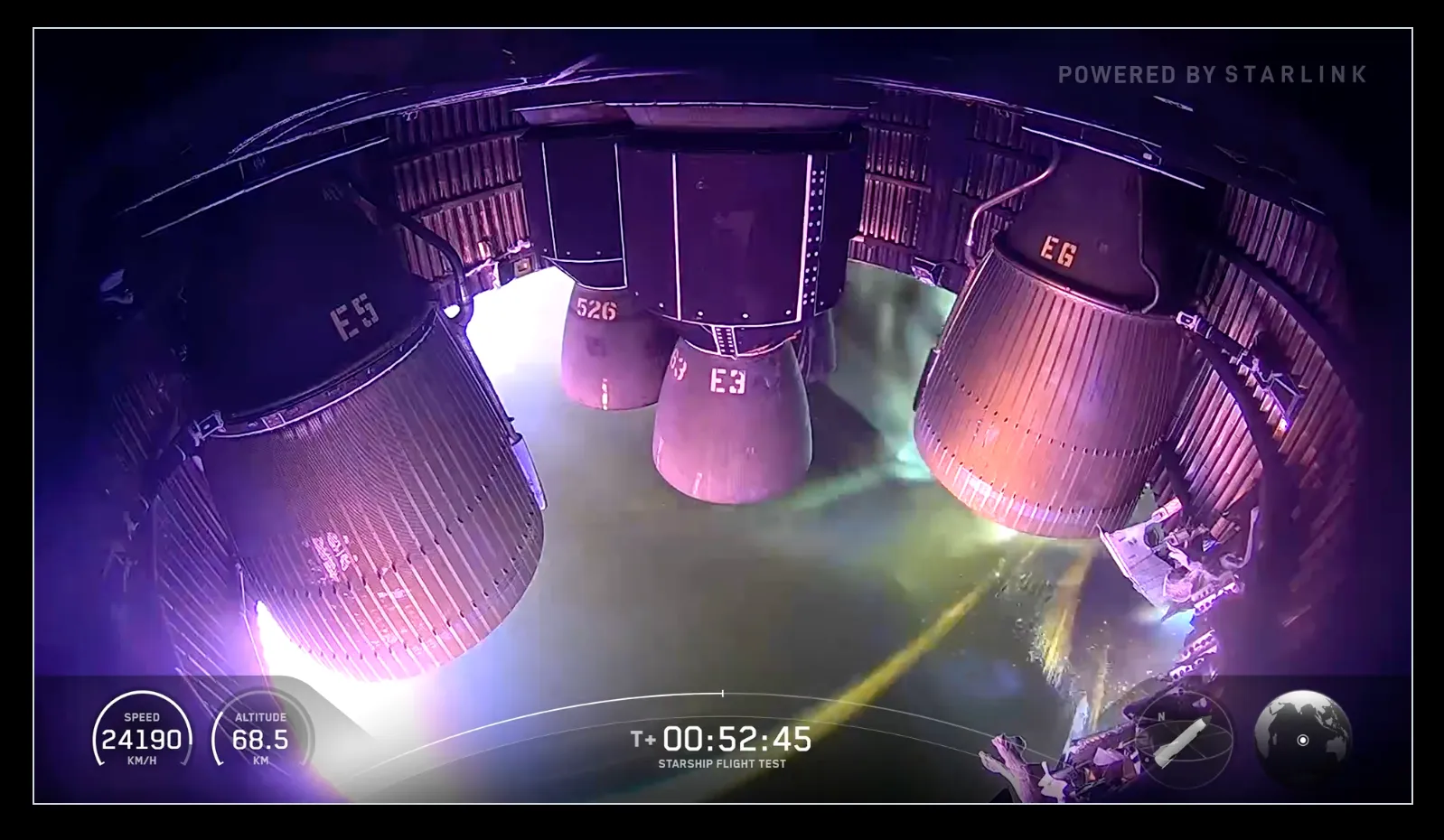
Last night’s Starship flight test achieved its core goals: clean ascent and staging, first-ever payload-bay operations with eight Starlink V3 mass simulators, re-entry experimentation with intentionally “bad” TPS conditions, and a flip + landing-burn to splashdown in the Indian Ocean captured on buoy-cam. It’s a major step toward routine payload missions.
Quick facts
- Launch & ascent. Nominal liftoff and climb through Max-Q; hot-staging with six Raptors on Ship, booster boostback toward the Gulf.
- Payload-bay ops. Door opened on orbit; first deployment at ~T+18:27; eight simulators released about one per minute; sequence completed successfully.
- Re-entry experiments. Ship flew with missing and metallic tiles and intentionally high flap loads to expand margins before full orbital missions. Past-peak-heating call made on the way down.
- Splashdown. Three-engine landing burn, flip, splashdown confirmed on buoy video; on-air “Farewell Ship 37.”
What was new — and why it matters
Payload door & deployment chain. The team pre-vented the nose cone to vacuum (a fix after an earlier fuel-diffuser issue that once kept the door from opening). With pressures behaving, the door opened and the “PEZ-dispenser” advanced cleanly through all eight releases — a full end-to-end rehearsal for Starlink V3 missions.
Data-first re-entry. As the hosts underscored, “the main payload is data.” Flying with deliberate TPS imperfections and high flap loads generated the stress data needed for future RTLS-class entries; cameras even hinted at minor superficial heating on a flap skirt while the vehicle stayed in control.
Network context. The segment on Starlink framed why Starship’s V3 launches matter: an 8,000-plus-satellite constellation already in orbit and ~60 Tb/s of added capacity per future Starship V3 launch.
The overlooked detail: a mockup taps the airlock frame
In the video, one Starlink simulator strikes the top of the airlock frame as it exits. That moment wasn’t called out on-air, but it’s worth examining because it lives at the intersection of mechanism dynamics and aerostatics in a venting cavity:
- Tight tolerances + stack advance. The PEZ system advances rows; depending on tolerances, the top unit can ride slightly high. Minor rail misalignment, pad compression, or thermal growth could lift the leading edge a few millimeters—enough to graze the frame.
- Transient forces. Even after pre-venting, residual gas jets and door-actuator motion can create gentle cross-flows. In micro-g, a small lateral impulse can rotate the satellite about its CG, pitching its nose upward at the moment of ejection.
- Ejection profile. If a pusher’s initial velocity is a touch low, the unit spends longer near the threshold where door clearance is tightest, increasing the chance of contact.
Likely impact. On mass simulators: cosmetic scuffing and sensor-noted impulses; on flight hardware, risk would be edge-chipping, antenna cover abrasion, or door-seal wear if unaddressed. Nothing here suggests a show-stopper, but it’s the sort of “paper-cut” that teams usually fix quickly.
What a next iteration might do:
- Add/adjust lead-in chamfers or low-friction sacrificial bump strips along the upper frame.
- Tweak pusher timing/force so the stack clears with a slightly higher initial speed.
- Open the door a degree or two more (if hinge/actuator loads allow) to increase vertical clearance.
- Tighten rail guidance and metrology checks on the top position in each row.
- Refine vent sequencing to minimize cross-flow right at deploy.
Given how rapidly SpaceX iterates deployers, expect this to be instrumented, replayed in slow-mo, and corrected before carrying revenue Starlinks.
Condensed mission timeline
- Liftoff; climb through Max-Q. All nominal.
- Hot-staging & separation. Six Raptors on Ship; booster starts boostback toward Gulf splashdown.
- Payload-bay operations. Door opens; first simulator at ~T+18:27; eight total at ~1/min; sequence complete.
- Re-entry testing. “Past peak heating” call; flap-load stressing; subsonic; engines chill for landing burn.
- Finale. Flip + landing burn; splashdown confirmed on buoy-cam; “Farewell Ship 37.”

No comments yet