When a billionaire’s rocket disappears in a fireball, etiquette is not the first thing expected to survive. Yet after Blue Origin identified a main oxygen valve as the starting point of the New Glenn test accident, Elon Musk’s response was not a victory lap. It was a simple expression of support for a quick return to flight. Coming from the founder of SpaceX, the company Blue Origin is trying to challenge, that gesture says rather more than billionaire banter.
The first lesson is that rivalry is not the same as animosity. Musk and Jeff Bezos have traded jabs, competed for contracts and pursued overlapping visions of the heavens. None of that requires genuine hatred. Spaceflight is a small village. Its inhabitants understand what an exploding rocket means: years of work erased in seconds and an organization forced to turn embarrassment into evidence. Musk knows that landscape. Sympathy here is not softness. It is recognition between practitioners of the same unreasonable craft.
The second lesson is that the commercial space race is less zero-sum than its headlines suggest. SpaceX wins contracts when it is reliable, cheap and available. But the market also grows stronger when Blue Origin, United Launch Alliance and others fly reliably. Customers gain options. Governments gain redundancy. The public begins to regard orbital transport not as a spectacle but as infrastructure.
Blue Origin’s valve problem illustrates this interdependence almost comically. Humans speak of lunar settlements, Mars cities and planet-spanning satellite networks; oxygen meets one uncooperative piece of plumbing and the future is asked to wait in the lobby. The BE-4 engine does not matter only to New Glenn. A version powers ULA’s Vulcan rocket. New Glenn, meanwhile, is tied to NASA’s lunar ambitions and Amazon’s broadband constellation. One faulty component can cast a shadow over several companies at once. The rocket business celebrates heroic founders, but it behaves like an ecosystem.
That leads to a third lesson: civilization advances through the conquest of boring details. Grand visions attract capital, talent and political patience. Yet no vision has ever opened a valve, validated a weld or closed a fault tree. The future arrives disguised as revised tolerances, redesigned seals and another hot-fire test. This is true beyond rockets. Artificial intelligence depends on cooling systems and power substations. Fusion depends on durable materials. Humanoid robots depend on joints that do not seize. Tomorrow is glamorous from a distance and deeply mechanical up close.
The fourth lesson concerns failure. The impressive part of Blue Origin’s response is not that a rocket failed; rockets have found theatrical ways to fail since rockets existed. What matters is the sequence afterward: recover hardware, isolate the origin, test components, modify the design, retrofit engines and rebuild the launch operation. A serious engineering organization is not one that promises never to stumble. It turns a stumble into a shorter syllabus for the next attempt.
SpaceX made this philosophy fashionable by testing visibly and iterating quickly. Blue Origin has historically projected a more cautious temperament. But real missions make rivals converge on the same truth: learning speed is a competitive advantage. Companies need not exchange blueprints to teach one another. One demonstrates that reusable boosters are possible; another responds. One improves engine economics; another lowers costs. Competition becomes an argument conducted with hardware.
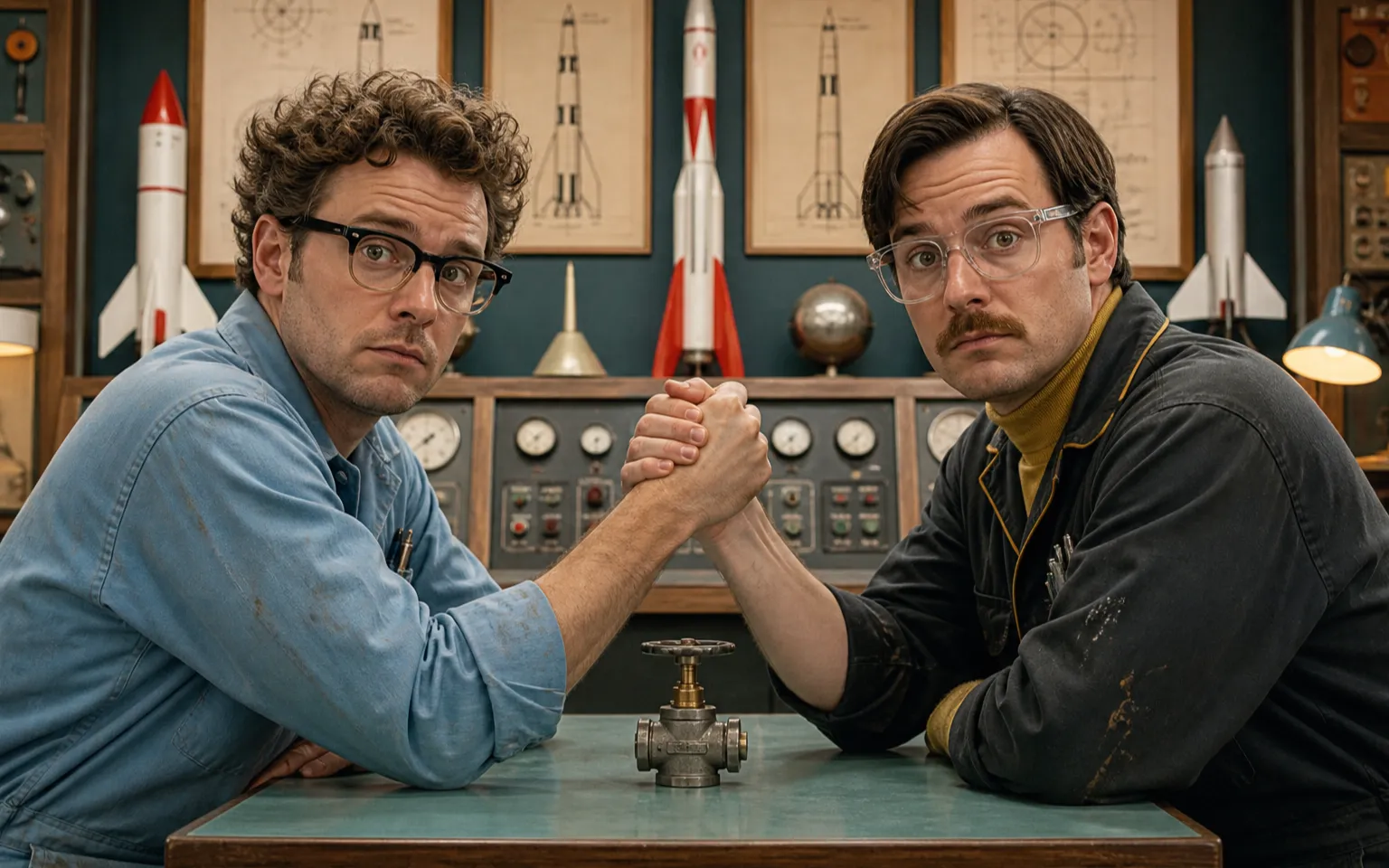
There is also a fifth lesson behind the celebrity names: the billionaires are not the whole story. Musk and Bezos provide capital, risk tolerance and persistent visions. But a rocket does not care about net worth, follower counts or who delivered the sharper meme. It responds only to physics. The real protagonists are the teams inspecting scorched metal, comparing sensor traces and asking which assumption survived longer than it deserved. A friendly message between founders briefly punctures the myth that history is made by two men arm-wrestling above the atmosphere.
The sixth lesson is strategic. A world with one dominant launch provider may look efficient, but it is fragile. A grounded fleet, technical defect or geopolitical dispute can suddenly become everybody’s problem. Multiple capable launch systems are civilizational insurance. They create spare routes to orbit for science, communications, navigation, defense and exploration. SpaceX should want Blue Origin competent enough to be irritating. A rival that forces better prices, faster innovation and contingency planning is more valuable than a defeated opponent.
Finally, tone matters. Commercial space depends on public trust, regulatory permission, skilled workers and communities willing to live near machines that occasionally shake windows. Treating every failure as humiliation turns exploration into a circus. Treating it as information—without minimizing risk—creates a healthier norm: investigate honestly, repair intelligently and try again.
Musk and Bezos will not become a two-man book club. They will continue fighting over contracts, launch cadence, broadband customers, lunar missions and the right to define humanity’s next frontier. Good. The point is not peace. It is mature rivalry: wanting the other side strong enough to sharpen you, safe enough to continue and ambitious enough to enlarge the market.
The old space race produced a winner and a flag. The new one must produce an industry. Its prize is not a single triumphant footprint but durable transportation beyond Earth. Seen that way, encouragement after failure is not merely good manners. It is a compact statement of the future: there is room in the sky for more than one builder, and nobody—not even a billionaire—gets there alone.

No comments yet