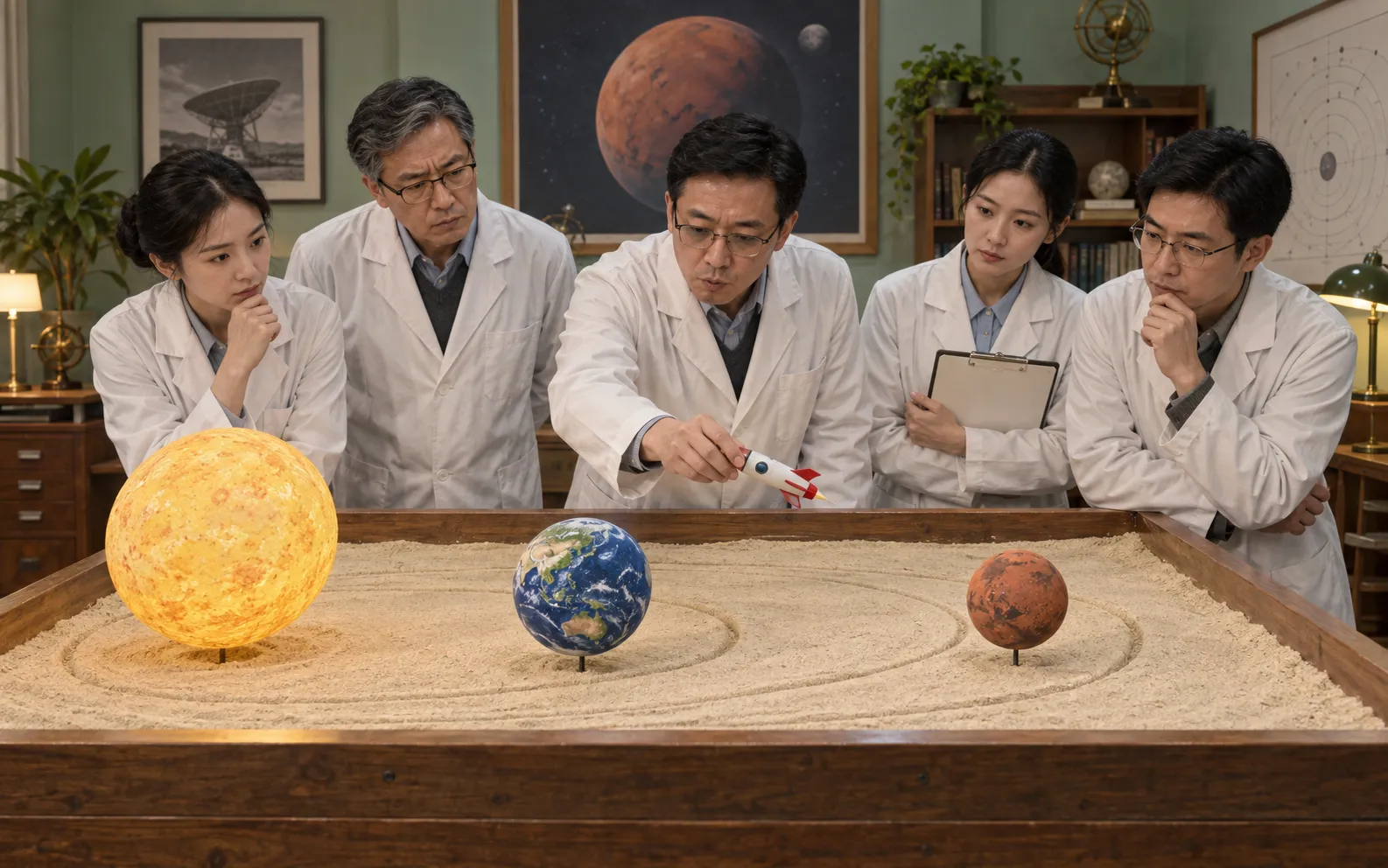
Mars has once again been asked to settle an argument between people who live on Earth. China plans to launch Tianwen-3 around 2028 and bring Martian samples home around 2031. This would be an extraordinary engineering achievement. It would also deliver a small consignment of rocks carrying the additional weight of Western anxiety. The return capsule will need excellent suspension.
The online debate comes with a familiar cast. There are patriots keeping score, accountants interrogating NASA, enthusiasts explaining how SpaceX will shortly make everything cheaper, and veterans of previous promised futures requesting delivery updates. The destination changes; the conversation remains remarkably stable. Before the first sample has left Mars, the discussion has returned to Earth’s most familiar terrain: other people being wrong.
Calling this a race makes the audience’s job wonderfully simple. Nobody needs to understand mineral chemistry. Just identify the flag and worry that it might be the wrong one.
The likely beneficiaries are easy to identify. Beijing gets a demonstration of technological prestige. American space advocates get a persuasive argument against budget cuts. Contractors get urgency attached to their proposals. Politicians get a scoreboard. Publishers get a headline with considerably more muscle than “Geologists Anticipate Interesting Work.” These interests can align without anyone attending a secret meeting. National insecurity is an excellent scheduling assistant.
The political packaging is hardly hypothetical. NASA’s September 2025 announcement of a potential Martian biosignature explicitly reminded readers that Perseverance had launched during Trump’s first term. Even a possible ancient microbe, it seems, must have its campaign affiliations checked before entering public life.
Competition can finance excellent science, and bringing samples home would be an extraordinary achievement. But scientific value does not obey medal-table rules. A later mission can answer questions an earlier one cannot. Mars will not stop containing information because somebody has already held a press conference.
Then comes the detail that sounds suspiciously like the opening act of a disaster film: planetary protection. China plans a laboratory to help prevent terrestrial contamination of Mars and ensure the safe isolation of returned samples. Somewhere, a screenwriter has already named the night watchman.
The precautions have serious purposes. Outbound cleanliness helps prevent us from contaminating Mars and then discovering ourselves. Terrestrial contamination could compromise the interpretation of returned samples. Imagine spending billions to establish that a microorganism from a spacecraft assembly room has enjoyed a remarkably successful gap year. NASA/JPL’s explanation
On the return journey, containment protects Earth while researchers investigate unfamiliar material. Precaution does not imply that scientists secretly expect a Martian plague. It means that our confidence should be supported by procedures. An absence of confirmed Martians is a poor substitute for a properly sealed container.
Sterilization, however, requires a precise object. Sterilizing equipment or a container’s exterior is different from treating the sample inside. COSPAR’s planetary-protection policy provides for studying unsterilized material under strict containment; distribution requires life-detection and biohazard testing, or proven sterilization. Having sterilization capabilities does not mean that every specimen must be cooked before anyone examines it. The laboratory is allowed to possess an oven without becoming a restaurant.
That distinction matters because treatment can damage the evidence. Heat can alter sensitive chemical signatures; killing an organism would also frustrate attempts to study it alive. Ancient traces present a different problem from living microbes. A sensible protocol must protect both the biosphere and the experiment. “We found nothing after boiling everything” would be a disappointing contribution to astrobiology.
Nevertheless, let us make a bet. Ten euros says that within five years of Tianwen-3’s samples reaching Earth, we will have no broadly accepted confirmation of Martian life, past or present, and an impressive harvest of hints.
Intriguing hints. Compelling hints. Hints requiring further investigation, preferably with a successor mission.
This is a wager about results and their presentation, not advance knowledge of what the rocks contain. A small collection cannot settle the biological history of an entire planet. Finding no evidence in those samples would leave plenty unknown. Mars is allowed to be complicated, even when the headline has already booked a victory parade.
There is already a useful example. Perseverance’s Cheyava Falls findings became a peer-reviewed potential biosignature, with nonbiological explanations still not ruled out. That qualification is scientifically necessary. A suggestive chemical pattern needs competing explanations tested before it becomes evidence strong enough to establish life.
The commercial temptation is to promote each improvement in “perhaps” as another arrival at “almost certainly.” Uncertainty acquires a launch schedule. Readers are invited back for the next thrilling episode of a rock remaining difficult to interpret.
Scientists deserve room to say that they do not know. They also deserve funding for answers that contain no organisms whatsoever. Returned samples can illuminate geology, water, climate, and planetary history, while laboratories on Earth offer analyses a rover cannot perform. Knowledge need not crawl out of a petri dish to justify the journey.
I would happily lose the ten euros. Independently confirmed Martian life would be magnificent, whoever brought the evidence home. Meanwhile, let China launch, let researchers compare results, and let safety engineers remain unfashionably meticulous.
Perhaps the most urgent sterilization procedure should be reserved for the press release. Remove the national panic, the premature triumph, and the promise of imminent revelation. Then examine what remains.
With luck, it will be science.



No comments yet