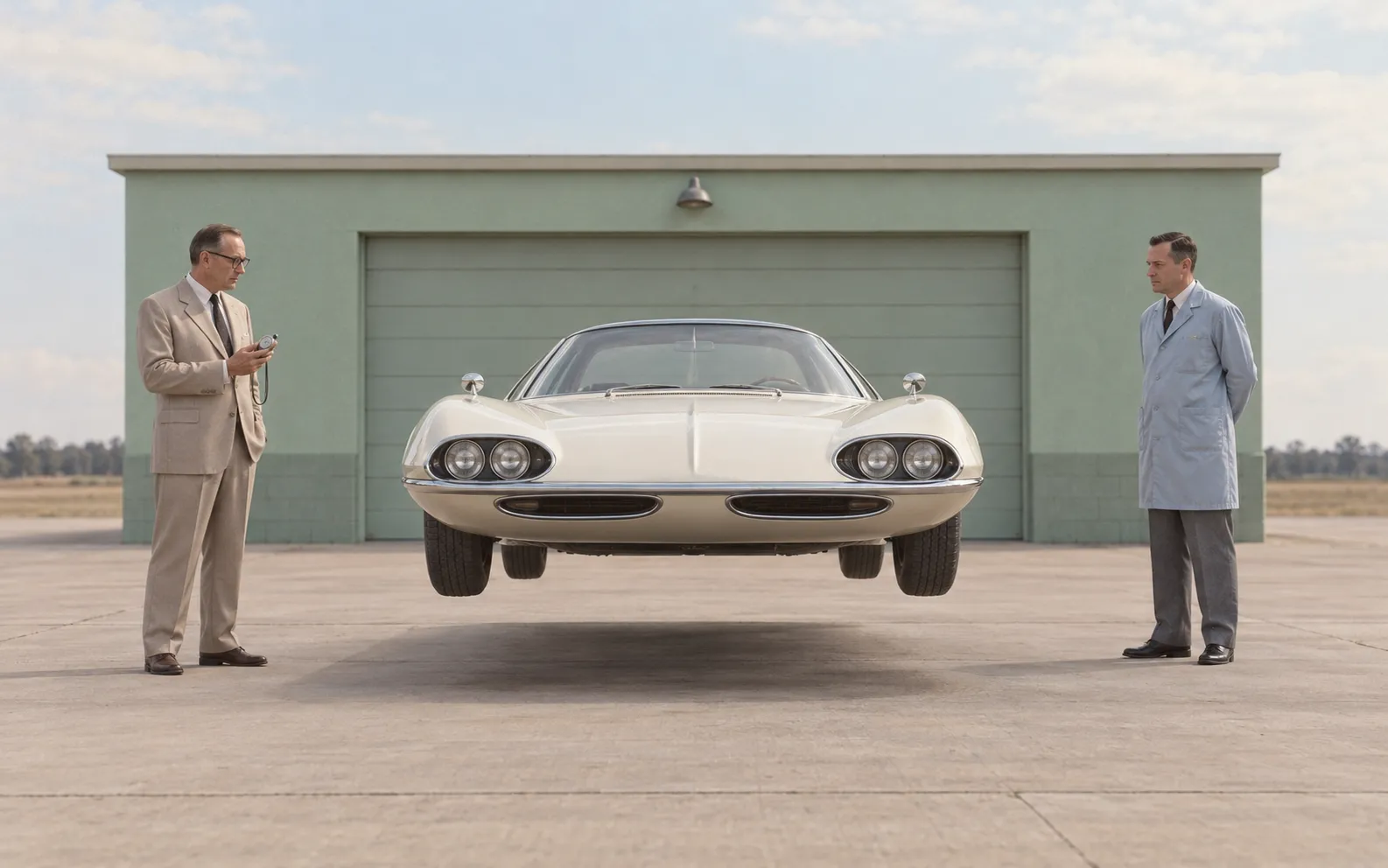
When I watched Knight Rider, I was perfectly willing to accept a talking car. The red light was excellent. The dry wit was a bonus. But the button that mattered was Turbo Boost. Press it, and the tedious business of remaining on the road became somebody else’s problem. A barrier appeared; Michael Knight declined to acknowledge it. This seemed an entirely reasonable direction for automotive development.
Then came Blade Runner, with cars drifting above a city that looked as though the future had forgotten to pay its electricity bill but maintained an extravagant neon budget. The social arrangements were troubling. The weather was appalling. I nevertheless found myself concentrating on the vehicles. Yes, humanity appeared to be in considerable difficulty. But had anyone noticed how beautifully the police car took off?
For years, adulthood offered a disappointing correction. Cars acquired parking sensors, heated steering wheels and increasingly elaborate ways of connecting to phones. Useful developments, certainly. But somewhere between the fourth Bluetooth pairing attempt and an advertisement celebrating additional cupholders, it became reasonable to ask what had happened to the future we had ordered.
Elon Musk, evidently, had kept the receipt.
At Tesla’s October 15 Roadster presentation in Texas, a prototype climbed an inverted ramp, launched into the air, performed a barrel roll and returned to the ground with assistance from SpaceX thrusters. Tesla also demonstrated a claimed 0–60 mph time of roughly 0.8 seconds. Production is promised for 2028; what we have today is a spectacular demonstration, with the practical questions of ownership still ahead.
Still. A car did a barrel roll.
There are moments when the responsible adult should be invited to finish his spreadsheet in another room. He will be needed shortly. There will be questions about maintenance, insurance and what precisely one tells the recovery service. For a few seconds, however, the child who watched Turbo Boost deserves uninterrupted access to the screen.
Calling this Roadster “quite fast” would be rather like describing a volcanic eruption as a promising source of warmth. We have spent decades watching sports-car manufacturers shave fractions from acceleration figures, each improvement accompanied by photographs of a serious man beside a carbon-fibre component. Tesla has now added a further question to the discussion: must the tyres remain involved throughout?
It is an absurd question. I am delighted that somebody funded the answer.
Musk has a particular gift for making the distinction between an engineering meeting and a conversation among twelve-year-olds unexpectedly difficult to identify. Can we make it faster? Can we put rocket technology in it? Could it briefly leave the ground? Somewhere in this process, highly qualified people must calculate stresses, write control software and explain why the exciting part cannot happen until Thursday.
Those people deserve their share of the applause. Behind every apparently ridiculous machine are engineers doing exceptionally unglamorous work. A public demonstration lasts seconds; getting the machine to behave requires patience that no promotional video can adequately convey. Musk supplies the appetite for the outrageous. Teams turn that appetite into something capable of landing.
And what a magnificent inconvenience this presents to the committed Musk-hater.
Imagine preparing a perfectly serviceable evening of disapproval. The familiar objections are arranged neatly on the desk. The man is theatrical. The promises are extravagant. Everything takes longer than announced. Then a car rotates in mid-air, and one must somehow maintain the appropriate facial expression.
An exhausting assignment.
The temptation will be to explain immediately why it does not count. It flew too briefly. It needed a ramp. It is impractical. Ordinary people cannot use it to fetch groceries. All legitimate subjects for discussion, although I cannot recall groceries featuring prominently in my childhood requirements for a flying car. My specification was substantially shorter: car; airborne; preferably mine.
Of course a brief aerial manoeuvre is a considerable distance from cruising above Los Angeles in a Blade Runner spinner. We should keep the distinction clear. But there is something comical about watching an extraordinary demonstration and responding chiefly with disappointment that it has failed to complete the entire science-fiction genre.
The Roadster has accomplished enough to earn a grin.
That grin need not become a political commitment. Enjoying a machine does not require adopting its maker’s opinions, defending every statement he has made or volunteering for permanent service in an online argument. We once understood this quite naturally. You could admire an aircraft without commissioning a comprehensive moral portrait of everyone involved in its manufacture.
Perhaps we could recover a little of that freedom. It would make technology considerably more enjoyable.
There is also room in the world for extravagant things whose immediate contribution is excitement. Nobody needs a sports car that performs aerial gymnastics. Very few childhood dreams emerge intact from a strict needs assessment. Submit Turbo Boost to a procurement committee and you will receive improved boot access, delivered eighteen months late.
I would prefer that our future retain the occasional glorious excess: an engineer given an unreasonable challenge, a team stubborn enough to attempt it, an audience briefly forgetting to be sophisticated.
We can return to the delivery dates tomorrow. We can examine the specifications and ask difficult questions. Today, somewhere between Michael Knight’s dashboard and the rain above a fictional Los Angeles, a small piece of childhood has acquired working hardware.
Please allow it a moment in the air.
No comments yet