There was a time when the future dressed like a washing machine. It was white, bulbous, padded, hygienic, and faintly punitive. The astronaut, that saint of national optimism, did not so much wear a spacesuit as disappear into one. He became an appliance with boots. The helmet reflected everything except the face inside it. This was fitting. Space exploration, in its heroic phase, preferred the human body to be treated as a temporary inconvenience: fragile, leaky, vain, perspiring, and therefore best encased in a portable bureaucracy of hoses, valves, seals, and acronyms.
Now the astronaut wears Prada.
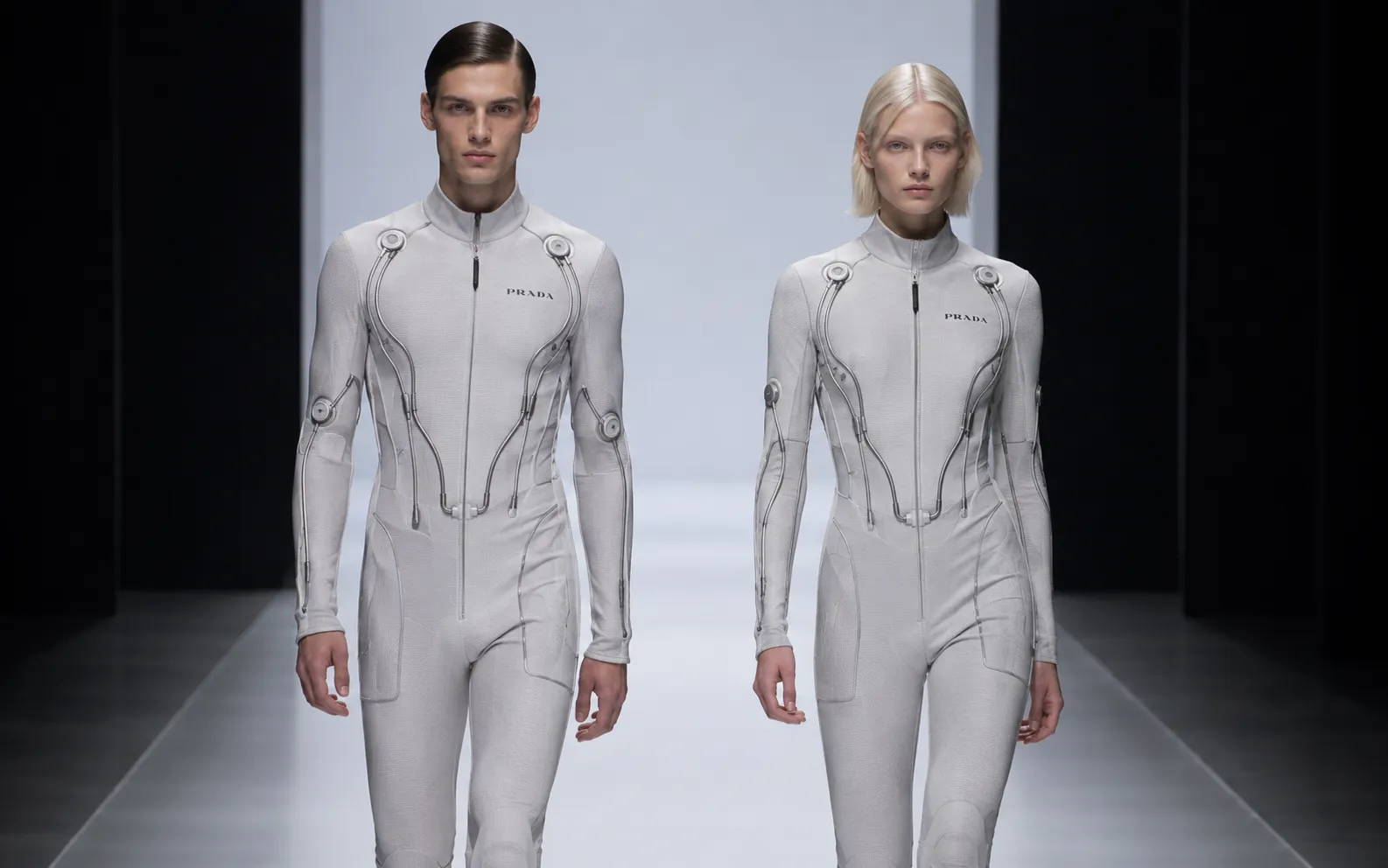
Not metaphorically, not in the sense that some marketing department has placed a triangular logo on a helmet and called it a new era, but in the more interesting and faintly comic sense that Prada has actually become part of the design conversation around lunar clothing. Axiom Space and Prada have moved from the outer shell of the new lunar suit to the thing underneath: the Liquid Cooling and Ventilation Garment, which is a phrase so determinedly functional that it sounds as if it were invented to prevent anyone from saying “moon underwear.”
Naturally, everyone said moon underwear.
This is unfair, but not entirely. Space has always depended on garments that nobody in the control room wished to describe too intimately. The grandeur of a lunar landing rests, in part, on the successful management of sweat. The astronaut may plant a flag, collect samples, speak in the grave clipped cadence of history, and gaze upon Earth rising above a horizon of powdered basalt; meanwhile, beneath the shining exoskeleton, cold water is being circulated around major muscle groups, carbon dioxide is being whisked away, and a very expensive long-sleeved underlayer is trying to keep the most mythologized worker in civilization from overheating.
The comedy lies in the collision of vocabularies. Prada belongs, in the public imagination, to Milan, runways, severe tailoring, desirable handbags, impossible cheekbones, and people who know how to look bored in sunglasses. Axiom belongs to Houston, systems engineering, oxygen loops, pressure vessels, test protocols, and the sort of meeting in which “comfort” is probably followed by “requirements matrix.” Put them together and you get the strangest luxury object of the century: a garment whose ultimate purpose is not to flatter the body, but to keep the body from dying.
And yet the partnership is less absurd than it first appears. A spacesuit is not a spaceship one climbs into. It is clothing promoted to architecture. It must bend, seal, insulate, cool, ventilate, protect, and forgive. It must tolerate dust sharp enough to be an enemy, temperatures theatrical enough to shame a sauna, and the indignity of being used by actual humans with shoulders, knees, backs, habits, fears, and insufficient patience. Bad clothing is annoying at dinner. Bad clothing on the Moon is a mission failure.
Fashion people know things engineers sometimes pretend are trivial until physics humiliates them. They know that a seam is not a line but a decision. They know that a fold can become a pressure point, that a fabric can behave beautifully in the hand and treacherously after hours of movement, that the body is not a cylinder with aspirations. They know that fit is not vanity. Fit is function with manners.
There is also a pleasing historical loop here. The Apollo spacesuit, now preserved in museums with the solemnity of a medieval relic, did not descend fully formed from the temples of aerospace masculinity. It came partly from the world of latex, stitching, bras, girdles, and women whose craft was precise enough to become existential. The moonwalk was, among many other things, a triumph of sewing. The heroic machine age depended on hands that understood cloth.
So perhaps Prada is not an intrusion into spaceflight but a return of the repressed. The space program has always been haute couture for catastrophically hostile environments. Each suit is bespoke, overbuilt, symbolic, and wildly expensive. It exists to transform a person into an image and an image back into a functioning person. The astronaut must look like the future while remaining, inconveniently, alive.
The amusing part is that luxury fashion and space exploration share more DNA than either side might admit. Both are industries of theatrical scarcity. Both sell impossible access. Both speak fluently in limited editions. Both understand the power of the reveal. Both can make adults say “drop” without embarrassment. Both are, at their worst, overfunded myth factories; at their best, disciplined attempts to make matter obey imagination.
The difference is that a Prada jacket may change how one enters a room. A Prada-Axiom cooling garment may determine whether one can leave the airlock.
This is where the joke becomes serious. The Moon is not a backdrop. It is not a brand activation with regolith. It is a vacuum with scenery. The new lunar suit is being designed for a region far less forgiving than the Apollo postcard Moon: the South Pole, with its severe thermal gradients, low sun angles, shadowed craters, and fine abrasive dust. If humans return there, they will not be strolling through nostalgia. They will be working inside machines shaped like clothing.
Still, one hopes Prada has smuggled in some elegance. Not elegance as decoration, but elegance as the absence of unnecessary suffering. A glove that tires the hand less quickly. A layer that routes tubes without making the wearer feel trapped in plumbing. A garment that acknowledges, discreetly, that astronauts are not just mission assets but bodies under pressure. This would be a fine revenge of fashion upon engineering: to prove that comfort was never softness. It was survival.
The Devil Wears Prada gave us fashion as combat, fashion as hierarchy, fashion as an office theology conducted in heels. The astronaut version is better. Here the stakes are not who gets seated at a runway show, but who can bend down on the Moon, pick up a rock, and stand back up again.
There will, of course, be jokes. There should be jokes. Humanity is preparing to return to the Moon dressed, in part, by Prada. Somewhere between the oxygen loop and the red stripe, civilization has produced an image so ridiculous that it must be true. But beneath the joke is a reminder worth keeping: the future rarely arrives in the costume we expected. Sometimes it arrives as a rocket. Sometimes as a checklist. Sometimes as a garment with cooling tubes.
And sometimes the devil does not wear Prada.
The astronaut does.
No comments yet