We like to imagine technology as a giant upgrade screen. Humanity discovers fire, unlocks the wheel, clicks “supersonic flight,” and the achievement glows permanently in the menu. Once acquired, a capability is ours forever. Civilisation, in this reassuring picture, is a game with excellent autosave.
Reality is ruder. Progress has a subscription fee. Stop paying—in money, training, institutions, supply chains, political attention or sheer collective nerve—and the feature quietly disappears.
“Lost” is a slippery word. It can mean forgotten knowledge, dismantled industrial capacity or simply a service nobody maintains. These are not equivalent. Antikythera is technological amnesia; Concorde is an expired business model; Apollo is an ecosystem in hibernation. But from the viewpoint of somebody trying to use them on Tuesday, all three buttons currently do nothing.
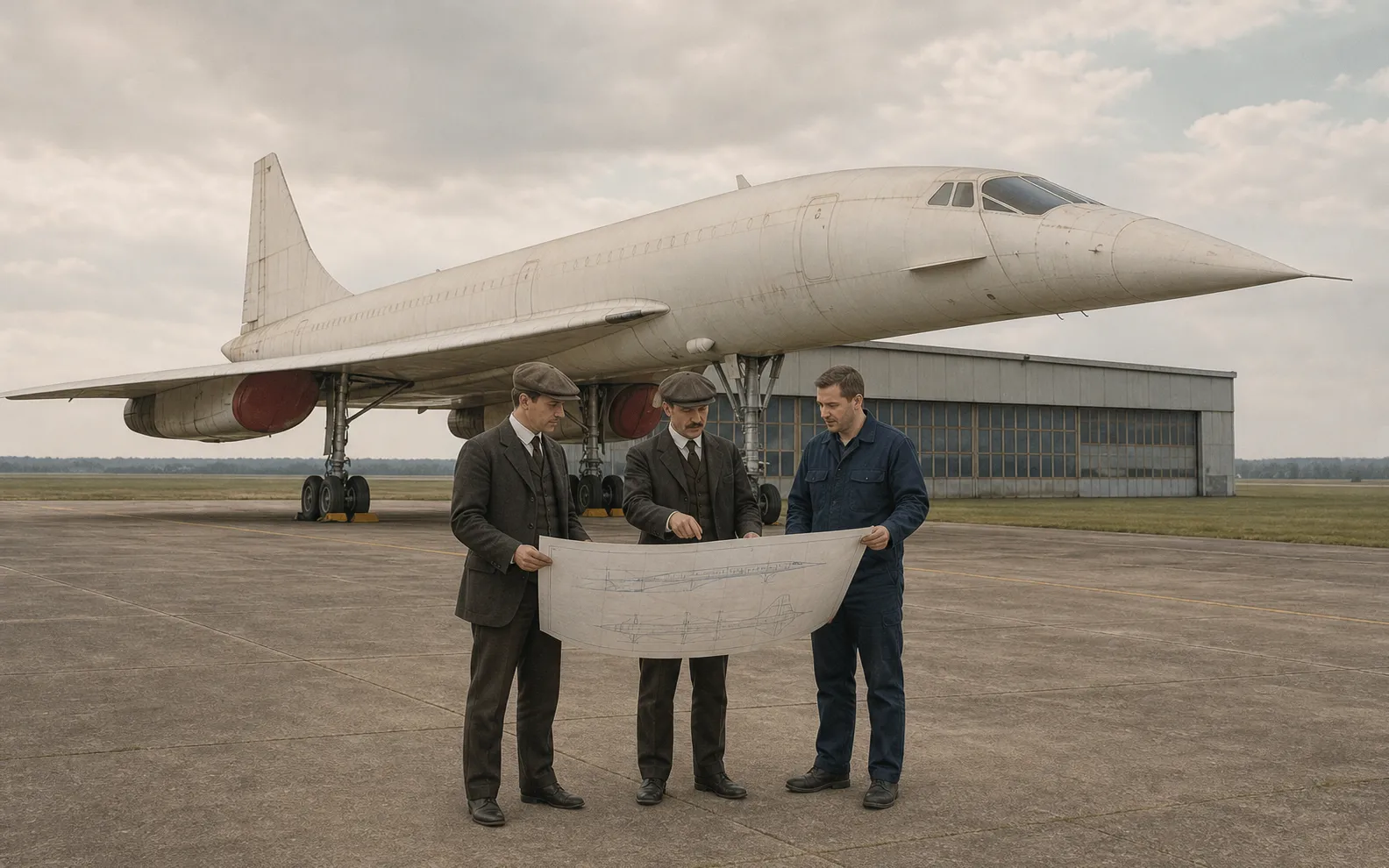
Consider Concorde. Until 2003, a fare-paying passenger could leave London and reach New York in a little under three and a half hours. Today, more than two decades of miraculous innovation later, the same passenger gets roughly eight hours, Wi-Fi of a philosophical rather than practical nature, and a touchscreen containing the complete works of Dwayne Johnson.
We did not forget the equations of supersonic aerodynamics. Concorde was retired after the 2000 Paris crash, the post-9/11 collapse in premium travel, rising maintenance needs and the withdrawal of long-term manufacturer support. Noise, fuel consumption and limited routes had already made its business case rather eccentric. The capability did not die in a laboratory. It died in a spreadsheet. Humanity still knows how to cross the Atlantic faster than sound; humanity merely cannot sell you a ticket.
The Moon is the grander example. The Wright brothers made the first controlled powered flight on 17 December 1903. Apollo 17, the last crewed lunar landing, left the Moon in December 1972: not quite 69 years later. As of 2026, roughly 54 years have passed since then. We are already more than three-quarters of the way through the entire interval from Kitty Hawk to the final Apollo footprints—and still those footprints have no younger human neighbours.
That does not mean modern engineers are inferior to Apollo engineers. It means “land people on the Moon” was never a single invention. It was a temporary ecosystem: rockets, spacecraft, launch pads, test facilities, hundreds of suppliers, armies of technicians, and a government willing to buy the whole improbable orchestra. NASA stopped funding additional Saturn V hardware before the first Moon landing; the assembly line was essentially shut in 1968. The drawings survived. The orchestra went home.
This is why the popular story that NASA “lost the blueprints” is misleading. A blueprint is not a factory, just as a menu is not a restaurant. You can possess the recipe for a soufflé and still lack the oven, the chef, the ingredients and the confidence to serve it to three astronauts while it is travelling at 39,000 kilometres per hour.
The Space Shuttle left behind a narrower but revealing absence. It was costly, dangerous and entirely reasonable to retire. Yet it could also bring very large objects back from orbit in a 60-foot cargo bay and land them on a runway. On one 2005 mission, Discovery returned with more than 25,000 pounds of equipment. Today’s Dragon capsule can return significant cargo—up to 6,614 pounds—but not a school-bus-sized payload. We gained a smaller, more regular capsule service while surrendering one peculiar form of celestial removals service.
This is not proof that civilisation is moving backwards. Capabilities branch; budgets do not. We traded some spectacular, specialised machines for satellites, reusable boosters, pocket supercomputers and global communications. That is probably a good bargain. But it means technological progress is not a rising tide that lifts every vehicle, especially not Concorde. It is more like reorganising a workshop: the new tools are astonishing, yet somehow nobody can find the 14-millimetre socket.
Sometimes the loss is more literal. The Antikythera mechanism, built in the second or first century BCE, was a densely geared mechanical computer that displayed astronomical and calendrical information. Nothing of comparable technological complexity is known for another thousand years. Its makers did not leave humanity a useful tutorial called “Ancient Greek Computer Build—No Spoilers.” The craft tradition appears to have vanished, and history had to climb the hill again.
There is also a hopeful counterexample. In 1960, Jacques Piccard and Don Walsh descended in Trieste to Challenger Deep, the deepest known part of the ocean. Nobody even attempted the journey again until James Cameron returned in 2012. By 2019, another crewed submersible had gone deeper. The capability slept for 52 years and was rebuilt. Apparently subscriptions can be renewed, although sometimes this requires a film director with unusually expensive hobbies.
But the most impressive human capabilities are not always machines. In 1980, the World Health Organization declared smallpox eradicated after a global campaign of vaccination, surveillance and case tracing. It remains the only human infectious disease we have eliminated worldwide. Smallpox was an unusually obliging enemy: it had no animal reservoir, its symptoms were conspicuous, and an effective vaccine existed. Our failure to repeat the trick is therefore not proof of simple incompetence. Even so, the scarce technology may be international coordination: a machine whose moving parts are governments, health workers, trust and patience. It is notoriously difficult to lubricate.
The laws of nature have not revoked our account. We could rebuild most of these things. But if restoring a capability requires years, billions and the reconstruction of expertise, then it is unavailable in the only sense that matters when you actually need it.
This is the less comforting, more useful view of progress. Humanity does not accumulate abilities like trophies in a cabinet. It keeps them alive through practice. A technology is not merely an idea; it is a community that still knows what to do on Monday morning.
So the next time a new achievement is announced, we should ask two questions. First: can we do it? Second: what must remain healthy for us to do it again in 30 years?
The first question produces headlines. The second keeps the subscription active.

No comments yet