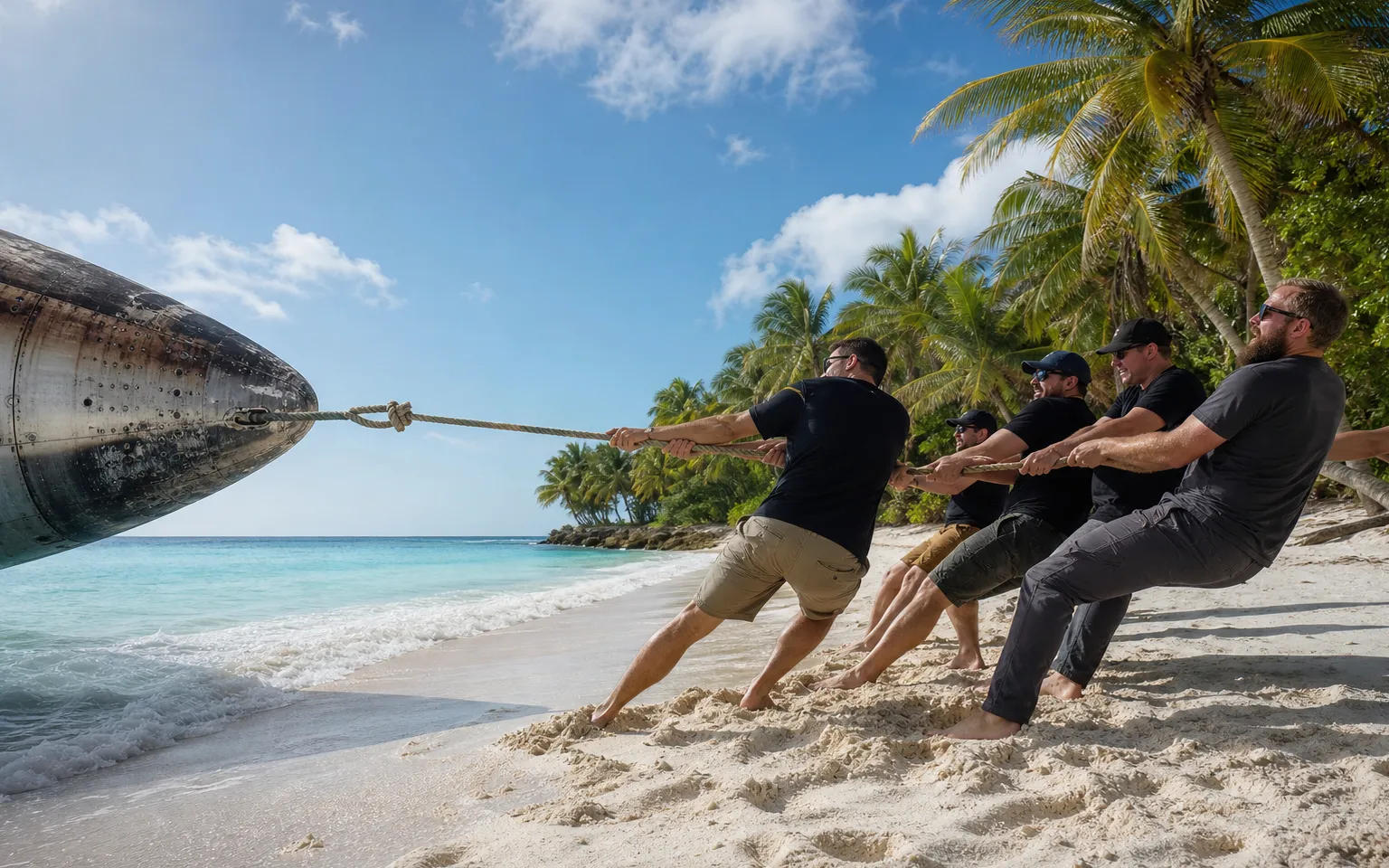
There is something wonderfully absurd about Ship 40’s latest destination. After roaring into space, surviving atmospheric re-entry and splashing down in the Indian Ocean, the 52-metre stainless-steel spacecraft has ended up just off Christmas Island. It was not carried there in triumph aboard some futuristic recovery vessel. It was towed.
Humanity has therefore reached a remarkable technological milestone: we can now build the largest rocket system ever flown, send part of it around the planet, land it in the sea—and then discover that the final stage of the mission requires a very long rope.
Ship 40 had already performed the part for which it was designed. It had flown on Starship’s thirteenth integrated test flight, endured the violence of re-entry and completed a controlled descent. It was expected to become another dramatic but expendable data point in SpaceX’s development programme. Instead, it remained inconveniently alive.
For weeks it floated in the Indian Ocean while recovery crews struggled with rough seas, improvised flotation devices and the unusual challenge of towing a spacecraft that had never been designed to behave like a barge. At one point even Elon Musk suggested that the recovery was not looking promising. Yet the battered vehicle persisted. After approximately 24 days at sea, SpaceX announced that its recovery team had guided it to calmer waters off Christmas Island, where engineers could conduct further analysis.
The result is a scene that seems borrowed from a particularly eccentric spy novel.
Somewhere near a remote Australian island rests one of the most technologically interesting objects on Earth: scorched, salt-encrusted, missing tiles and perhaps parts of a flap, but containing the physical record of an actual Starship re-entry. Around it, one imagines technicians, security personnel, tugboat crews and government officials all trying to look as though this sort of thing happens every Tuesday.
It does not.
Ship 40 is not valuable because anyone could refuel it and fly away. It will almost certainly never leave the ground—or water—under its own power again. Its value lies in what engineers call “ground truth”: the difference between what computer models predicted, what onboard sensors reported and what the hardware actually experienced.
Every distorted panel, cracked weld, scorched cable, damaged heat-shield tile and corroded fitting has a story to tell. The engines reveal how their materials survived re-entry, landing and prolonged immersion in salt water. The flaps show how aerodynamic surfaces endured extreme heating and stress. The stainless-steel structure contains evidence of loads that may have lasted only fractions of a second but could influence the design of every Starship that follows.
Telemetry tells engineers what happened. Hardware can sometimes tell them why.
Naturally, SpaceX is not the only organisation that might enjoy hearing the explanation.
Competing launch companies would be fascinated by the construction methods, material choices and thermal-protection system. Intelligence agencies might be curious about the engines, flight-control hardware and manufacturing techniques. China is developing its own reusable launch systems and would hardly be indifferent to a flight-tested specimen of America’s most ambitious rocket. India, an increasingly capable space power, would also have legitimate technical interest. So would Russia, Europe, Japan and probably any engineering department possessing a camera and a sufficiently adventurous intern.
That does not mean spies are currently approaching Christmas Island in fishing boats, wearing false moustaches and carrying unusually large toolboxes. There is no public evidence of such an operation. But the basic strategic interest is real. Rocket technology is inherently dual-use: the knowledge required to move payloads rapidly through the atmosphere has obvious civilian, commercial and military significance. Starship’s secrets are protected not merely because SpaceX dislikes competition, but because advanced propulsion and guidance technologies sit in a sensitive national-security landscape.
This gives the recovery an entertaining geopolitical undertone. Ship 40 may be the first spacecraft to require protection not while sitting on a launchpad, but while bobbing in tropical water. It is difficult to hide a silver object taller than many apartment buildings, especially when it has just arrived beside an island with fewer residents than a modest European village.
One can picture the security briefing:
“Is the vehicle concealed?”
“No.”
“Can it be moved into a hangar?”
“We would first need a hangar, a crane and possibly a different island.”
“Could someone photograph it?”
“They may already be doing so from breakfast.”
Fortunately for SpaceX, photographs of an exterior are not the same as possession of the technology. A modern launch vehicle cannot be reverse-engineered like a captured kitchen appliance. The real knowledge lies in manufacturing tolerances, software, metallurgy, test procedures and thousands of design decisions invisible to an observer. Even if someone obtained a heat-shield tile or an engine component, reproducing it reliably at scale would be an entirely different matter.
Still, physical artefacts matter. A single component can confirm suspicions, invalidate assumptions or reveal an elegant solution to a problem that has consumed years of research. Ship 40 is not a complete instruction manual. It is more like a book with several crucial pages left open.
Perhaps that is what makes its survival so captivating. Spaceflight is normally presented as a clean sequence of ignition, ascent, orbit and landing. Ship 40’s story continued after the cameras were supposed to stop. The spacecraft became flotsam, salvage prize, engineering laboratory and potential intelligence headache—all while slowly acquiring the appearance of an extremely expensive shipwreck.
If SpaceX eventually returns it to Texas, the vehicle may prove more useful after its flight than during it. Engineers will dismantle it, inspect it and translate its scars into changes for future ships. The public, meanwhile, receives something rarer than another polished corporate success story: a genuine adventure full of improvisation, uncertainty and stubborn machinery.
Ship 40 went to space and came back. Then the really interesting journey began.
And for the moment, the most closely watched spaceship on Earth is waiting beside Christmas Island—presumably wondering whether anyone remembered to bring wrapping paper.

No comments yet