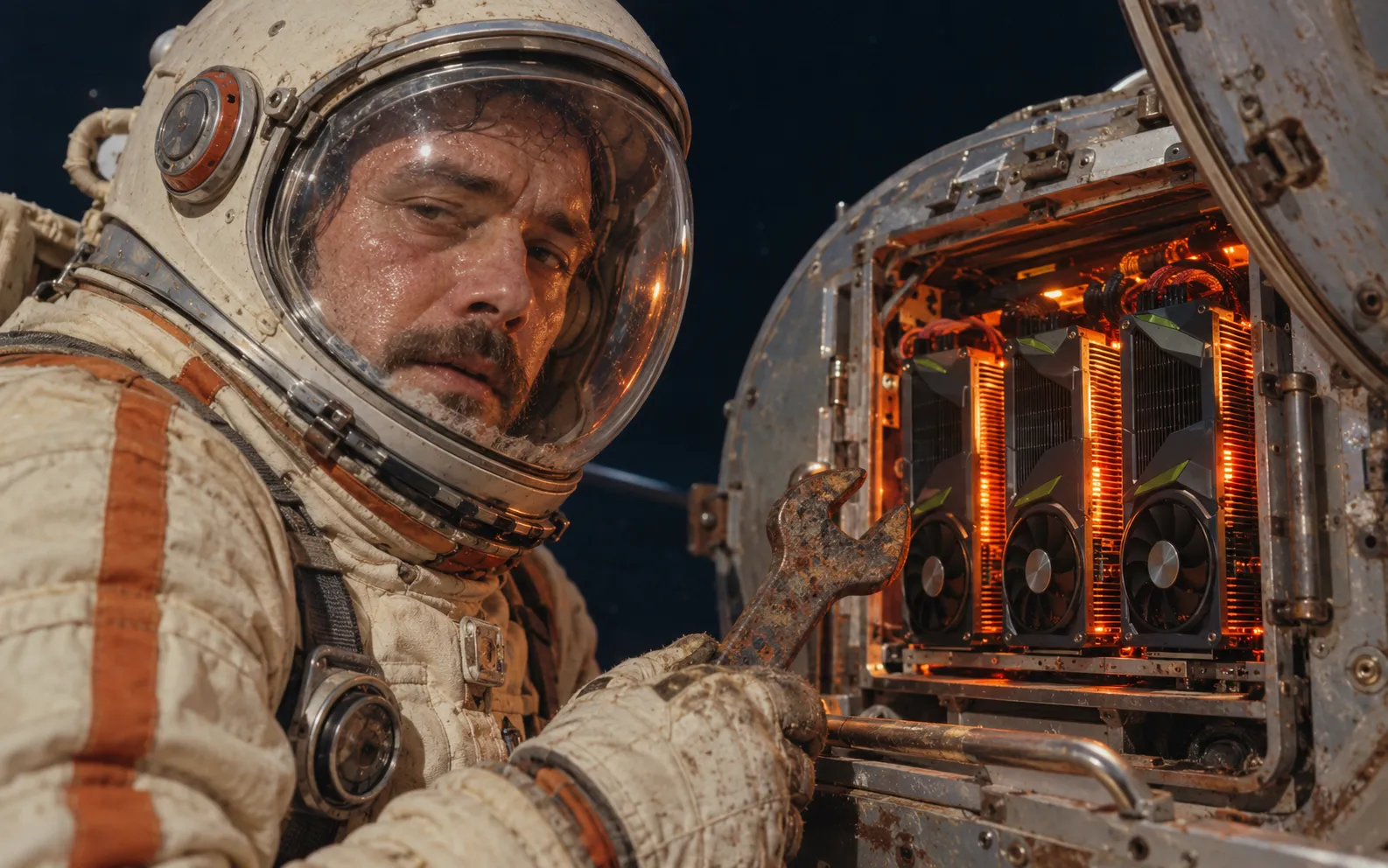
The cloud has spent years pretending to be weightless. In reality, it occupies buildings full of hot equipment, cables and people wondering why something has stopped working. Google is now testing whether part of that machinery could leave Earth. This is an excellent way to improve the view from the server room, although it complicates sending someone upstairs to check a cable.
On October 1, 2026, Google's Project Suncatcher prototype reached orbit aboard SpaceX's Transporter-18 rideshare mission. Built in partnership with Planet, the satellite established contact and was operating as expected, Google reported. Its job is experimental: discover how Google's Tensor Processing Units, or TPUs, handle launch stresses, radiation and the thermal conditions of space. A successful arrival begins that investigation; it does not establish an orbital cloud business.
The attraction is sunlight. In suitable orbits, solar panels can receive almost continuous illumination, avoiding clouds and most nighttime interruptions. Google estimates that orbital panels could harvest up to eight times as much solar energy as comparable panels on Earth. The ambition is a network of computing satellites connected by lasers. Imagine a server rack whose components have individual flight plans.
There is, however, a familiar domestic problem. Computers get hot. Space may look like the universe's largest freezer, but a freezer works partly because something carries heat away. A vacuum is exceptionally unhelpful in that department. It is also what makes a vacuum flask good at keeping your coffee warm.
On Earth, moving air or liquid transports heat away from processors. Spacecraft can still conduct heat through solid materials and circulate fluids internally, but there is no surrounding air to carry it off. The final escape route is thermal radiation: surfaces emit infrared energy into space. NASA's thermal guidance describes precisely this division between internal heat transport and external radiation. Installing a larger fan outside the satellite would mostly demonstrate confidence.
Google is investigating heat pipes and radiators to move heat from densely packed chips to surfaces that can shed it. Those surfaces need area, suitable coatings and a useful view of cold space. Sunlight, reflected sunlight and Earth's infrared emission complicate the balance. The solar panels want sunshine; the cooling system must manage unwanted heating. Designing both into one spacecraft is an exercise in negotiating with the same star twice.
Hotter radiators can emit more energy per square metre, but electronics have temperature limits, and heat must first travel from the chips to the radiator. More computing therefore demands more than another box of processors. It brings additional thermal hardware, mass and deployment requirements. The Sun supplies energy generously. Getting rid of the leftovers requires engineering.
For comparison, consider Microsoft's Project Natick, which put 864 servers in a sealed vessel off Scotland's Orkney Islands in 2018 and retrieved them in 2020. The surrounding sea provided a convenient destination for waste heat through heat exchangers. Space offers abundant sunshine and awkward cooling; the ocean offers useful cooling and a conspicuous shortage of sunlight at the server rack.
Natick also produced a delightful finding for anyone who has ever feared the office handyman. Microsoft reported a server failure rate one-eighth of its land comparison. Researchers suspected the dry nitrogen atmosphere and absence of people disturbing equipment helped. That was a result from a particular experiment, with proposed explanations, rather than proof that every computer improves when submerged. Still, humanity being a maintenance hazard deserves a place in the minutes.
Both projects make access difficult, which changes the meaning of reliability. Natick's vessel could be recovered with marine equipment. Orbital hardware has no comparable routine service visit. Google's research paper explicitly identifies replacement of failed TPUs as a challenge and suggests redundant provisioning as the simplest response. Carry spares, tolerate failures, keep working. The maintenance cupboard must be launched before anyone knows what will break.
Radiation adds another complication: energetic particles can upset stored data or damage electronics over time. Google's ground tests are encouraging, but surviving a radiation dose is only one part of proving a dependable computing system. Detecting errors, recovering workloads and keeping communications reliable remain essential. Nor can a software update repair a broken physical connection, however reassuring its release notes sound.
Where does SpaceX fit? For this mission, it supplied the launch; Planet is Google's named satellite partner. There is also an older relationship: Google Cloud and SpaceX announced a 2021 partnership to place Starlink ground stations at Google data centre properties. That agreement connected satellite internet with terrestrial cloud infrastructure. It does not, by itself, establish joint ownership or development of Suncatcher. The rocket, the spacecraft and the computing project have distinct roles.
Launch economics nevertheless matter enormously. Google's research explores whether falling launch prices could make orbital computing plausible, while explicitly stopping short of a complete economic analysis. Cheap transport would help every radiator, spare processor and replacement satellite. It would not abolish their costs. Neither would plentiful solar energy settle the environmental accounting for manufacturing, launches and eventual disposal.
Suncatcher is interesting because it subjects an extravagant idea to actual hardware tests. The results will matter more than renderings. Natick offered a similar lesson: unusual addresses can reveal useful engineering, even before anyone establishes a mass market. The sensible question is whether the entire system can become reliable, affordable and worthwhile. For now, Google has moved the experiment upstairs. The heat has come along, and the technician still needs a considerably better travel policy.


No comments yet