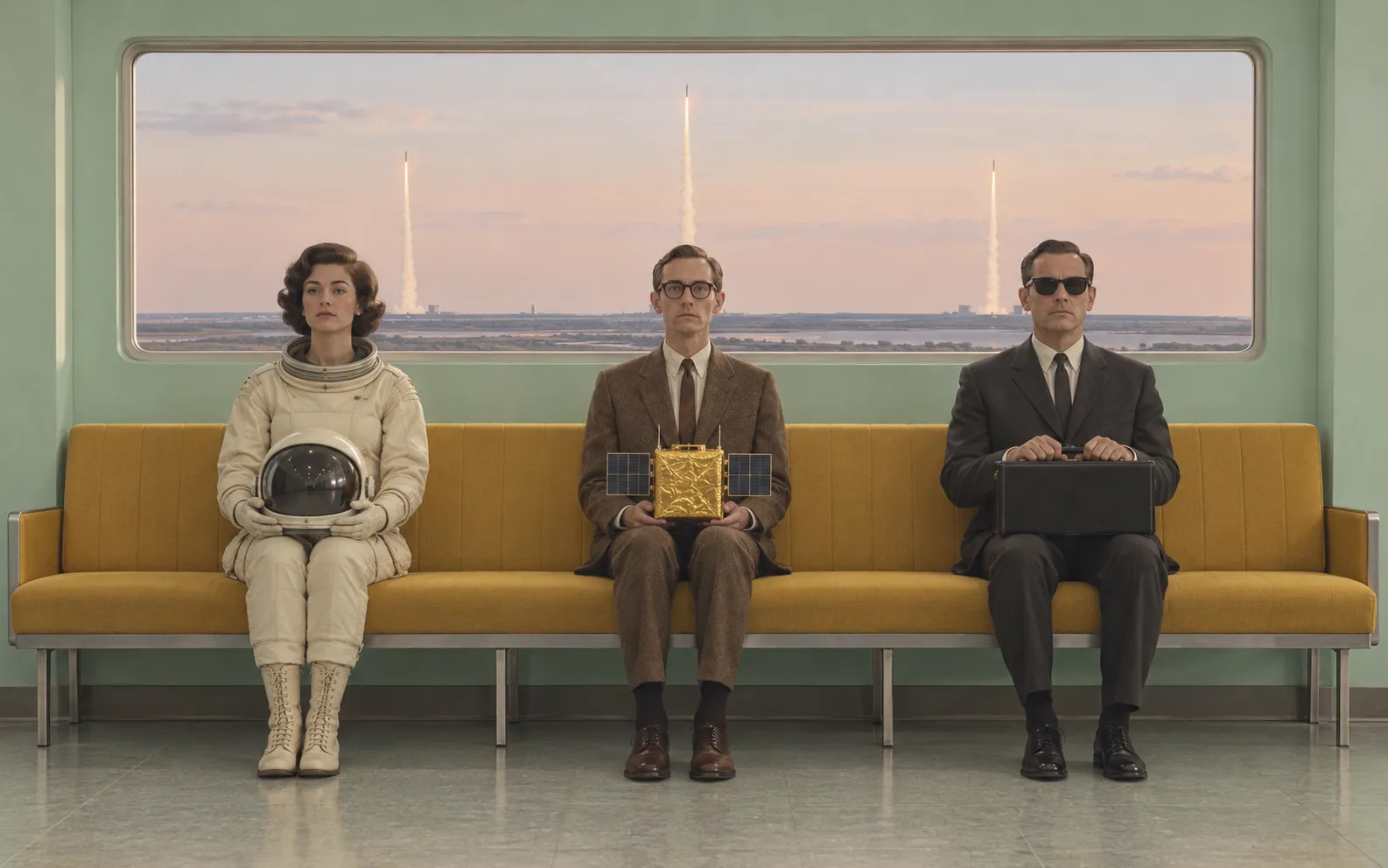
Most organisations consider it a productive Thursday if the printer works and somebody finally approves the travel expenses. On October 1, 2026, SpaceX fitted three rocket launches into twelve hours and forty-four minutes. Somewhere, a project manager with a six-week deadline for changing a website button should probably look away.
The programme had range. Four people bound for the International Space Station. A shared flight carrying 130 payloads. Then a Falcon Heavy carrying the NROL-97 mission for the National Reconnaissance Office, whose customers understandably prefer their deliveries without a detailed unboxing video.
It was an entire space economy compressed into one working day, provided your definition of working day extends almost to midnight and involves substantial quantities of liquid oxygen.
Crew-13 began proceedings at 11:10 a.m. Eastern time from Cape Canaveral. NASA astronauts Jessica Watkins and Luke Delaney, Canadian astronaut Joshua Kutryk and Roscosmos cosmonaut Sergey Teteryatnikov rode a Falcon 9 and Dragon towards the ISS. Humanity continues to demonstrate that international cooperation is possible, especially when everyone agrees that the air must stay inside. NASA
They also made excellent time. Dragon docked at 7:05 p.m. EDT, just seven hours and fifty-five minutes after launch, setting a new record for an American spacecraft’s journey from liftoff to ISS docking. Less than a working day to reach an orbiting laboratory: leave Florida before lunch, arrive at the space station that evening. Somewhere below, a passenger was still trying to establish which airport terminal their connecting flight had moved to. NASA
The familiarity is deceptive. A crew rotation sounds like something organised by a hotel manager. Here it means accelerating human beings into orbit, arranging a rendezvous with a moving laboratory and delivering them alive, with enough composure left to begin work. Calling this routine is an extraordinary compliment to the people responsible.
Across the continent, Transporter-18 departed Vandenberg at 11:32 a.m. Pacific time. Its 130 payloads included small satellites, hosted experiments and spacecraft carrying other payloads for later deployment. SpaceX’s mission report also records that the first-stage booster completed its twenty-fifth flight and returned to land. Twenty-five. Most of us would feel entitled to praise for reusing a shopping bag that often. SpaceX
Rideshare is a wonderfully unromantic name for something so consequential. It suggests splitting a taxi fare, which is roughly the economic idea, although the driver takes an unusually firm position on departure times and nobody can be dropped off outside the atmosphere on the way.
NASA’s passengers on that flight included missions to test propulsion, investigate ultraviolet light from the cosmos and develop satellite inspection capabilities. There is something deeply encouraging about advanced science travelling as shared freight. A researcher’s instrument does not become less ambitious because it has neighbours. It becomes easier to send. NASA
Then, at 11:54 p.m. Eastern time, Falcon Heavy launched NROL-97 from Kennedy Space Center. Its two side boosters returned to Cape Canaveral. The payload’s discretion offered an entertaining contrast with the delivery method: a secret carried into the sky by an enormous illuminated announcement. Apparently, confidentiality begins above the fairing. SpaceX
The variety is what gives the day its significance. Human spaceflight, shared commercial and scientific transport, and national security place different demands on a launch provider. Serving all three in rapid succession suggests an organisation capable of handling a complicated operating schedule, with different customers, vehicles, teams and consequences.
Behind each brief spectacle sit months of manufacturing, inspection, integration, training and coordination. Nobody wakes up on Thursday, checks the weather and decides to squeeze in a reconnaissance mission before bed. The achievement belongs as much to the work that never appears on camera as to the flames that do.
Reusability makes that hidden industrial story especially interesting. A booster on its twenty-fifth flight is an expensive piece of machinery earning its keep repeatedly. Recovering it does not eliminate maintenance, risk or cost. It does change the basic expectation: after helping launch the payload, valuable hardware can come home for another assignment.
Customers can plan around a service that operates repeatedly. Experiments gain opportunities to fly; spacecraft designers can think about what comes after a first demonstration. The launch itself gradually becomes one stage in a larger project. That is a considerable promotion for rocketry, even if it feels like a demotion for spectacle.
Which brings us, briefly, to the newsroom.
Imagine the predicament at a suitably earnest, establishment-left editorial conference. Three launches, astronauts delivered, boosters recovered: distressingly positive material. Unfortunately, the company is associated with Elon Musk, so spontaneous enthusiasm may require a safeguarding meeting. Perhaps the achievement could be acknowledged after a sufficiently long introductory clause about the billionaire’s controversial remarks. By then, the reader might reasonably assume the rocket had been charged with something.
Coverage plainly exists. Unembarrassed admiration should also be allowed. Musk’s politics need not become a compulsory preflight check for appreciating engineering. Musk’s role in building SpaceX deserves recognition; so do the engineers, technicians, launch crews and public partners who make its missions possible. Neither acknowledgement obliges anyone to endorse his next post.
NASA’s involvement also makes the public-versus-private shouting match look rather small. These flights show how much can happen when public institutions have serious requirements and a company develops the machinery to meet them. The useful question is whether the arrangement delivers. On this particular Thursday, delivery was conspicuous.
Perhaps that is the most satisfying development of all. Spaceflight is acquiring the qualities that make other technologies useful: repetition, availability and the ability to serve several purposes without each occasion requiring a national identity crisis.
We should preserve some capacity to be astonished by that. Familiarity can make competence disappear from view, leaving the argument about the proprietor occupying the entire screen.
Three rockets left Earth. Four people reached their new workplace. A great deal of expensive hardware came back.
The printer, meanwhile, is still waiting for IT.

No comments yet