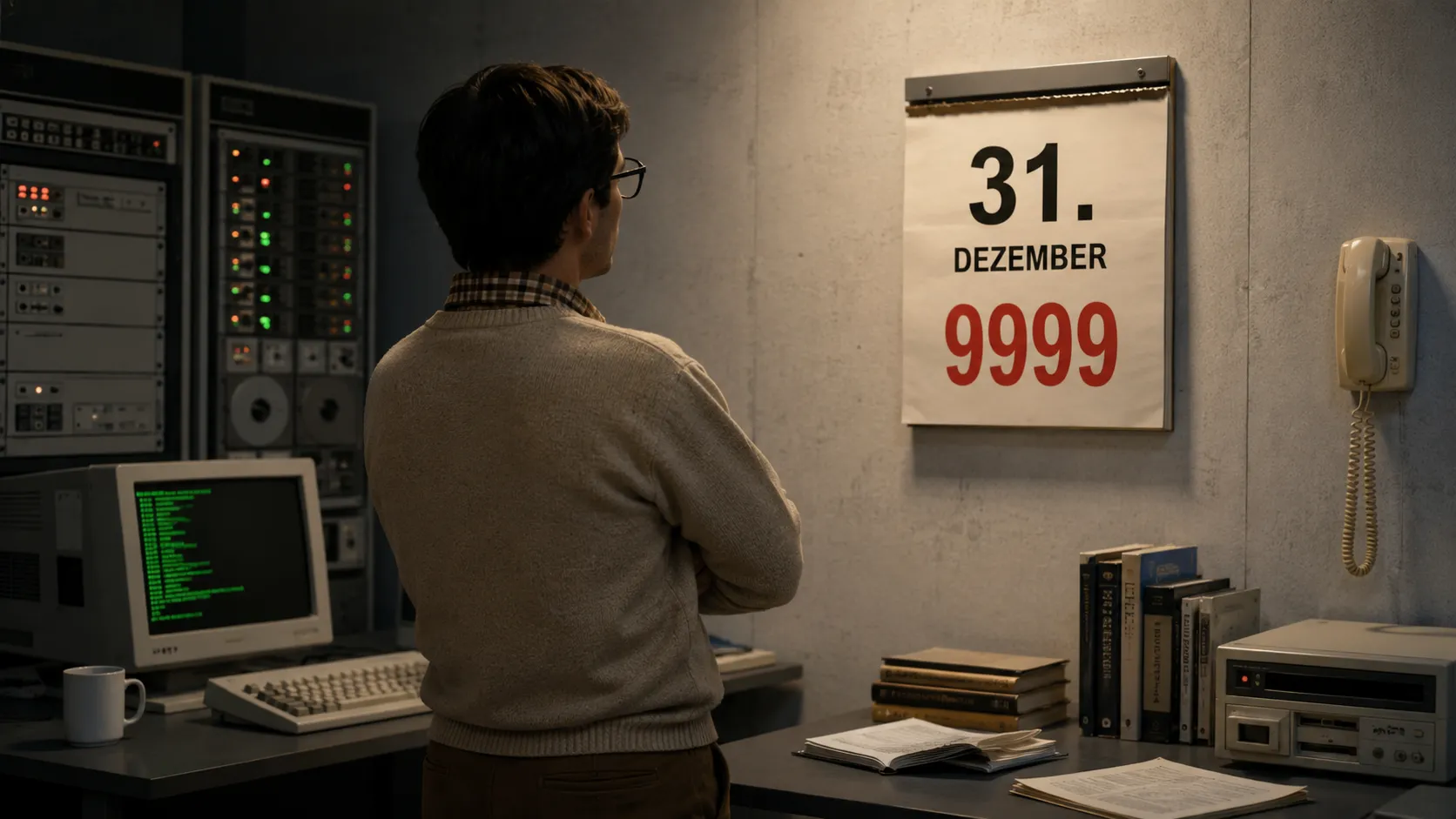
In 1999, civilization stood before the abyss, clutching a stack of floppy disks, a faxed emergency plan, and an unreasonable amount of canned food. The Year 2000 problem had a beautifully simple premise: somewhere in the bowels of the world’s software, dates had been stored with two digits, and “00” might be interpreted not as 2000 but as 1900. This raised several obvious questions. Would banks forget our money? Would elevators begin descending toward the reign of Kaiser Wilhelm? Would nuclear power stations politely melt down because a COBOL program believed it had missed a century?
As catastrophes go, Y2K had excellent branding. It sounded less like a software defect and more like an experimental nightclub drug. It had urgency, mystery, and just enough technical truth to make every reassurance sound suspicious. Sensible engineers explained that not every date bug implied apocalypse. Less sensible newspapers asked whether planes would fall from the sky. Consultants, meanwhile, discovered that fear with a deadline is a billable asset.
And so, across the world, people prepared. Governments prepared. Banks prepared. Utility companies prepared. Universities prepared. Research institutes prepared. Somewhere in Bonn, at a Fraunhofer institute, a group of serious people spent New Year’s Eve not under fireworks but under fluorescent lights, waiting for machines to misread time itself. What exact eventuality were they guarding against? That is the beauty of institutional emergency duty: the more undefined the disaster, the more necessary the coffee.
In the end, the century turned. Most lights stayed on. Most accounts survived. The machines did not rise. There were real glitches, but the much-advertised technological Ragnarok did not arrive. This produced the familiar retrospective argument: was Y2K exaggerated, or was it avoided precisely because armies of tired engineers had spent years fixing it? The correct answer is probably the least emotionally satisfying one: both, depending on where one looks. The problem was real; the panic was theatrical; the mitigation was often boring; the boredom was the victory. Major remediation efforts took place, and the eventual impact was mostly limited rather than catastrophic.
At the time, joking about the Y10K bug seemed safe. The year 10000 was far enough away to be delegated to descendants, archaeologists, or cockroaches with system administrator privileges. “We’ll meet again for Y10K” had the charm of a technical drinking song. It implied continuity. It implied that our software would still be a problem in eight thousand years. It implied, perhaps correctly, that mankind’s final act will be a schema migration.
Now we have Q-Day.
Q-Day is not a calendar event. There is no neat midnight at which the world’s RSA keys turn into pumpkins. It is the hypothetical moment when a sufficiently capable quantum computer can break widely used public-key cryptography at practical scale. The phrase has the same pleasing melodrama as Y2K, but the shape of the risk is different. Y2K was a date problem with a date. Q-Day is a deadline without a date, which is worse for project management and better for anxiety.
The public version is simple. Much of today’s digital trust relies on mathematical problems that are easy in one direction and hard in the other. Classical computers find them inconvenient. A large enough quantum computer, using the right algorithms, may find some of them much less inconvenient. This does not mean that your toaster will become self-aware and liquidate your pension. It means that key exchange, signatures, certificates, blockchains, secure messaging, software updates, and long-term confidential archives may all need serious attention. NIST finalized its first post-quantum cryptography standards in 2024, including ML-KEM for key encapsulation and ML-DSA and SLH-DSA for digital signatures.
The Y2K comparison is tempting because both crises involve invisible infrastructure and people in committees saying things that sound absurd until they are not. “We must inventory all cryptographic assets” has the same poetry as “Does the cafeteria badge reader understand leap years?” In both cases, the problem is distributed through layers of software, suppliers, protocols, old systems, new systems, undocumented systems, and systems maintained by a man named Frank who retired in 2011 but still has opinions.
Yet Q-Day is also more treacherous. Y2K mostly waited until the clock rolled over. Q-Day may have already begun in a quieter form: adversaries can record encrypted traffic now and decrypt it later, if the data remains valuable long enough. Official migration guidance explicitly warns about this “harvest now, decrypt later” problem. That gives the whole affair a wonderfully unpleasant quality. The future can attack the present retroactively. Somewhere, a packet capture is sitting in cold storage like a bottle of wine, waiting for mathematics to mature.
This makes the Q-Day readiness meeting less cinematic than one might hope. There will be no grand New Year’s Eve watch. No countdown. No champagne held nervously beside a mainframe. Instead, there will be asset inventories. Certificate lifetimes. Hybrid key exchange. Vendor questionnaires. Firmware updates. Procurement language. Test environments. Legacy protocols found under carpets. Someone will ask whether an old VPN appliance supports post-quantum algorithms. Someone else will say, “It depends what you mean by supports.” At that moment, one should cancel lunch.
There is comedy in this because our civilization keeps discovering that abstraction has physical consequences. We build vast symbolic machines and then act surprised when symbols leak into reality. Two digits for the year were once a sensible economy. Public-key cryptography was once a miracle of elegant asymmetry. Both decisions were rational within their age. Both later acquired the status of geological strata. The future does not arrive as a monster. It arrives as compatibility debt.
The sane reaction to Q-Day is not panic. Panic is just ignorance with better lighting. The sane reaction is preparation with dull tools: know where cryptography is used, shorten exposure where long-term secrecy matters, prefer systems with cryptographic agility, test post-quantum options, and stop pretending that “we’ll replace it later” is a plan. The United States, among others, has already treated the migration as a long-term federal priority, with guidance aiming to reduce quantum risk over the coming decade.
Still, one may hope that the Q-Day equivalent of that Fraunhofer New Year’s Eve will happen with style. A room full of engineers, security people, mathematicians, and one exhausted manager. A whiteboard saying “CRQC readiness.” Bad coffee. One suspiciously old system in the corner. At midnight, nothing visible happens. No alarms. No banking collapse. No molten reactor core. Just a log entry, somewhere, indicating that a deprecated cipher suite was finally disabled.
Then someone will say: “Good. We’ll repeat this for Y10K.”
And the youngest person in the room, not yet dead inside, will ask whether that is really necessary.
The rest will answer, as one: “We should start the inventory now.”


No comments yet